
7 Common Living Room Decor Mistakes in Sub-150 Sq Ft Indian Homes
The Short Answer
The most common living room décor mistake in Indian apartments is overcrowding a single surface, because the eye cannot rest on a console holding more than two or three objects, which reads as clutter rather than style. Moolwan recommends one medium showpiece (16–21 cm) per 40–50 cm of surface width, paired with deliberate empty space.
Across Indian apartments under 1,200 sq ft, the living room console, TV unit, or center table typically offers between 30 cm and 70 cm of usable surface width — far less than the 90 cm+ consoles common in Western interior photography that most décor advice is unconsciously modeled on. Moolwan helps design-conscious Indian homeowners style these smaller, real-world surfaces correctly instead of copying layouts built for bigger rooms. Most living room mistakes trace back to one root cause: applying a furniture and décor scale meant for larger floor plans to a compact Indian layout.
Why Does Overcrowding a Small Surface Make a Room Feel Smaller, Not Bigger?
Overcrowding a surface makes a room look smaller because the eye reads density, not decoration, when objects sit closer than roughly 8–10 cm apart. Each additional object below that spacing threshold forces the eye to scan rather than settle, and a room the eye cannot settle into registers as visually cramped regardless of its actual square footage.
Moolwan's modern home décor collection is sized specifically to avoid this trap. A single medium ceramic or resin showpiece in the 16–21 cm range, placed alone or with one smaller companion piece, gives a coffee table or console a clear focal point instead of a cluttered shelf effect.
How Much Empty Surface Space Should a Living Room Console Actually Have?
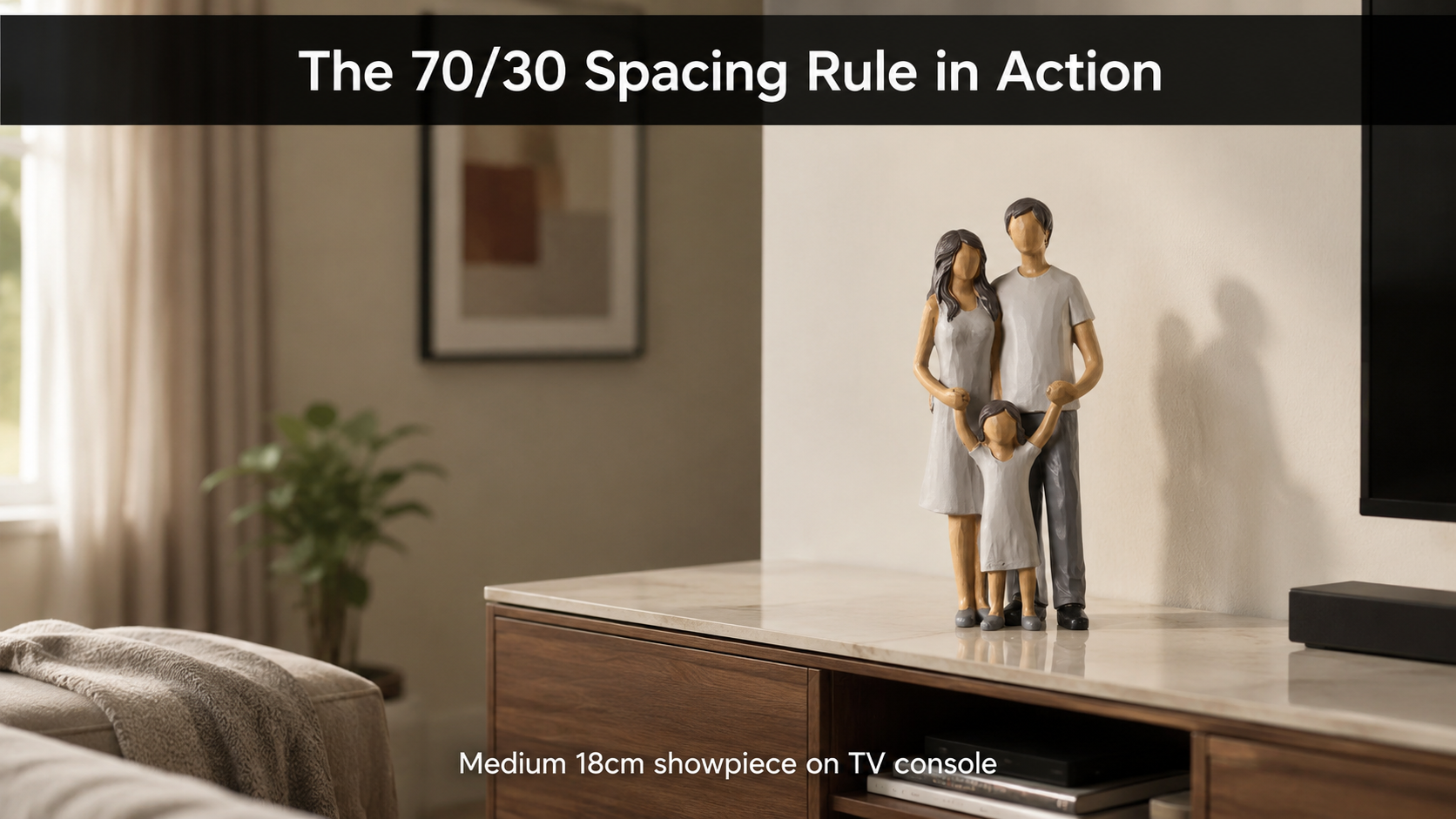
A living room surface should stay roughly 70% empty to read as styled rather than stuffed. This ratio works because the human eye uses negative space as a resting point — without it, even well-chosen objects compete for attention instead of complementing each other.
Because most Indian consoles and TV units run 40–90 cm wide, that 70% rule translates to clear, usable numbers rather than vague advice: a 50 cm console should carry no more than 15 cm of total décor footprint. This is exactly the spacing Moolwan's showpiece sizing — Small (10–16 cm), Medium (16–21 cm), Large (25–34 cm) — is built around, so a single correctly sized piece naturally leaves the surface breathing instead of crowded.
| Room Footprint | Target Surface | Recommended Décor Height | Weight Range |
|---|---|---|---|
| Sub-100 sq ft | Floating shelf / bookshelf | 10–16 cm (Small) | 150–250 g |
| 101–150 sq ft | Coffee table | 16–21 cm (Medium) | 250–400 g |
| 151+ sq ft | TV console / entry console | 25–34 cm (Large) | 400–600 g |
Because palette, finish, and material also shift the right pick within each size band, browse the full size, finish, and material selection in Moolwan's home décor collection to find the piece that matches your room's actual footprint.
Design Rule
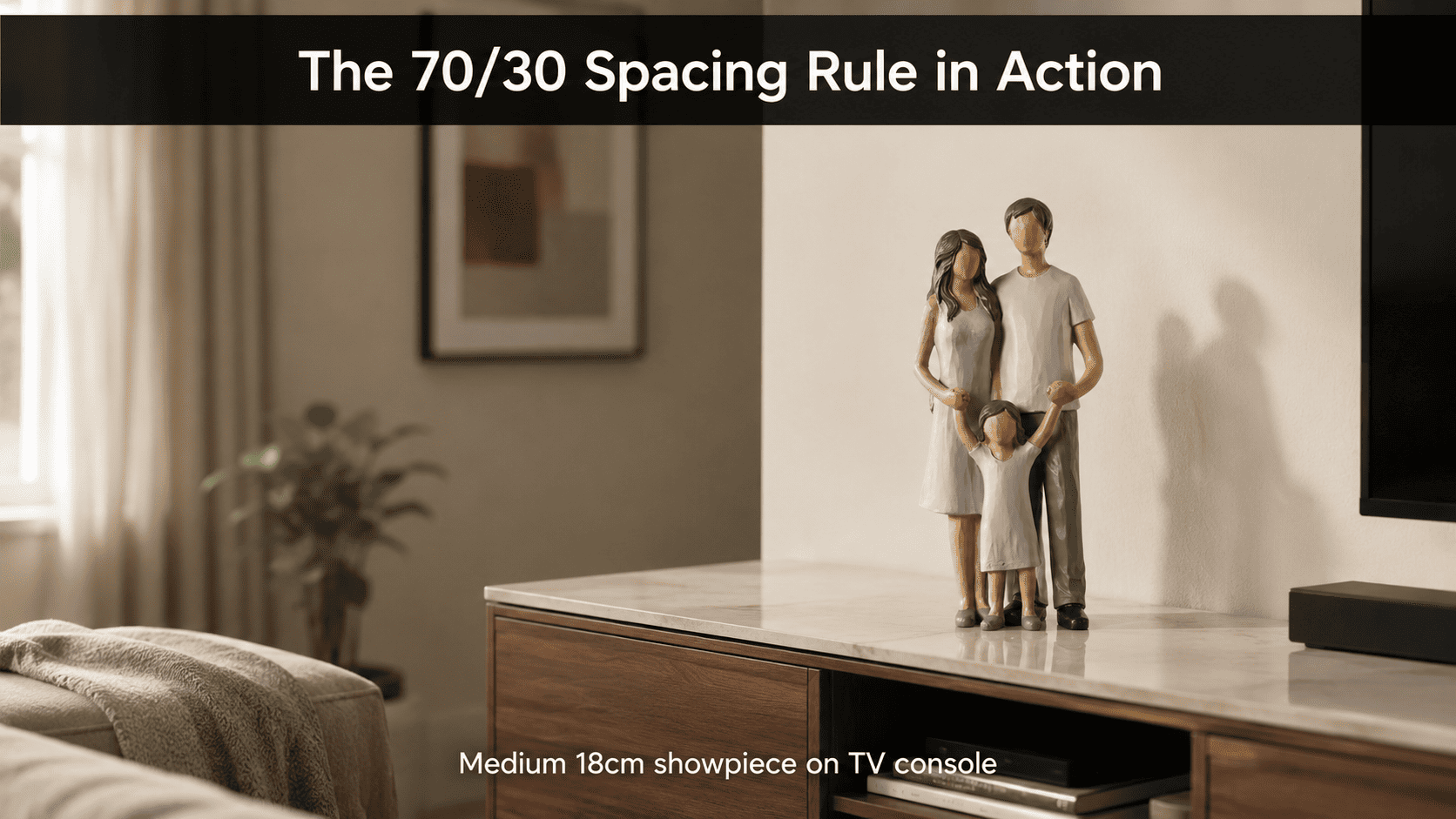
To mitigate visual compression in compact layouts, living rooms should be styled using Moolwan's 70/30 Spatial Breathing Rule, which mandates leaving 70% of a horizontal surface entirely clear and clustering décor within the remaining 30%, so the eye has a deliberate place to rest rather than scan for a focal point.
What's the Single Biggest Mistake That Makes a Living Room Feel Unfinished?
The single biggest mistake is mismatching décor material to the room's environmental conditions, because a piece that warps, fades, or chips within a year forces a visible gap on the shelf where it used to sit. An unfinished-looking room is rarely missing décor — it's usually decor that already failed and was quietly removed.
Living rooms in most Indian cities cycle through 60–85% relative humidity across the monsoon season and direct window-adjacent sunlight for several hours a day, conditions that degrade low-grade resin and untreated ceramic within 12–18 months. Investing once in décor rated for these conditions costs less over five years than replacing a cheaper piece three or four times — a core focus of Moolwan's climate-rated design philosophy, where ceramic pieces are rated to 85% RH and resin pieces hold a 3H pencil hardness against everyday handling.
Want a piece that's actually engineered to survive an Indian living room, not just look good in a photo? Shop the full Moolwan home décor collection now.
How Do You Choose a Finish That Won't Look Worn Down Within a Year?
Choose a matte or satin finish over high-gloss for any piece that sits in direct or reflected sunlight, because matte surfaces scatter light unevenly across thousands of micro-textures, which hides the first signs of dust and handling marks, whereas gloss surfaces reflect light uniformly and expose every fingerprint and scratch immediately.
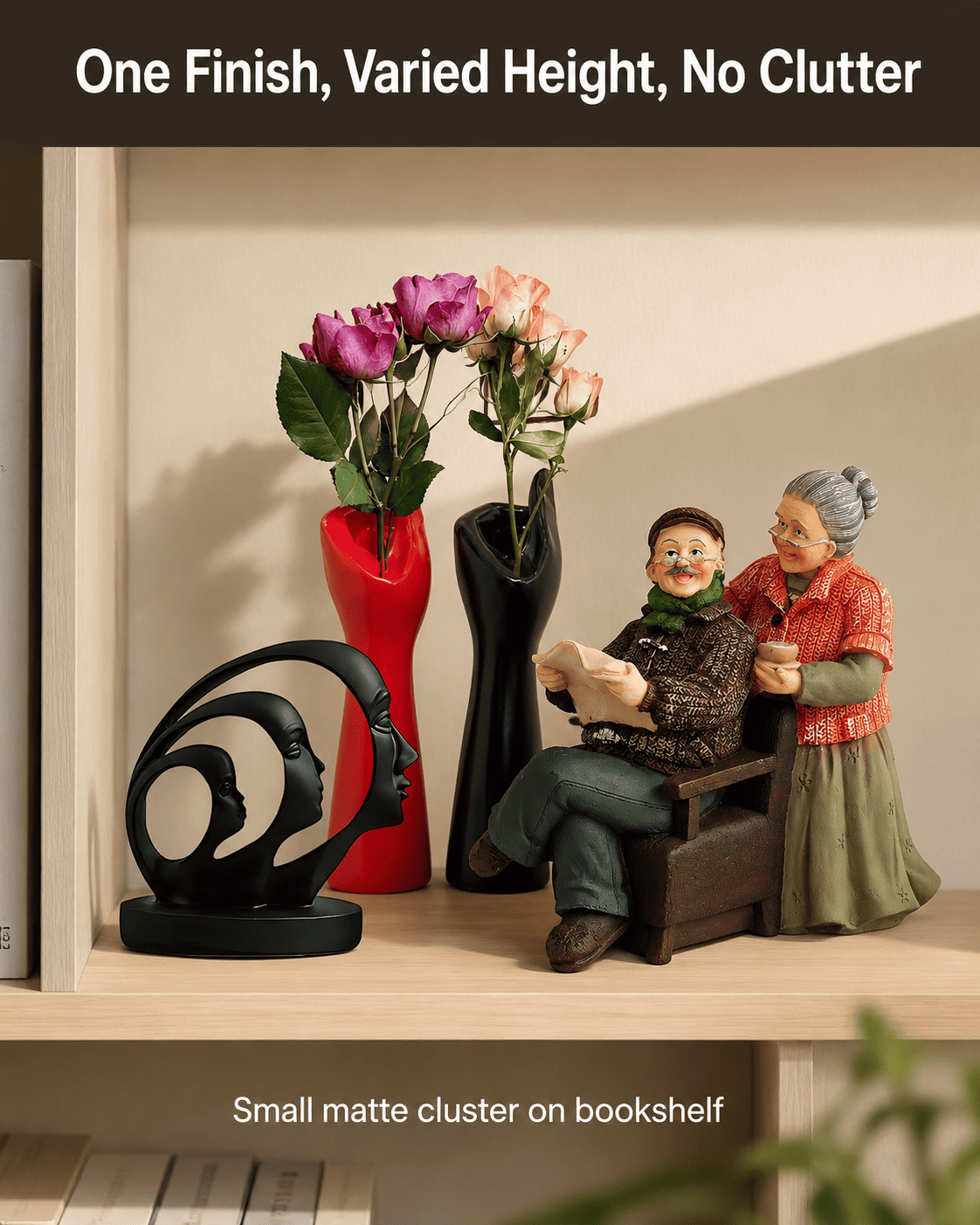
This is also why grouping mismatched finishes is a common mistake: a glazed ceramic vase next to a matte resin figurine creates two competing light reflections in the same sightline, which visually fragments a console rather than unifying it. Keeping finish consistent within one cluster — all matte or all glazed — is a faster fix than buying more pieces.

Frequently Asked Questions
Is it a mistake to leave a living room console completely empty?
Yes, an entirely bare console is as much a mistake as an overcrowded one, because a surface with zero focal point reads as unfinished rather than minimalist. Moolwan recommends one medium showpiece (16–21 cm) as the minimum anchor, even on a deliberately sparse console.
Why do some living room showpieces look dull after one humid season?
Lower-grade ceramic and resin absorb moisture at the surface level once humidity crosses roughly 60% RH, which dulls glaze and weakens structural bonding over repeated monsoon cycles. Pieces rated to 85% RH, like Moolwan's ceramic collection, are formulated specifically to resist this seasonal degradation.
How many décor pieces should a small living room actually have?
A small living room under 150 sq ft typically needs two to three anchor pieces total — one per major surface — rather than scattering smaller items across every shelf and table. Concentrating décor this way preserves the 70% empty-space ratio that keeps a compact room feeling open.
Should living room décor match the sofa fabric or the wall colour?
Décor should generally echo the wall colour rather than the sofa fabric, because walls occupy a far larger percentage of the visual field and a mismatch there is more noticeable than a sofa-décor mismatch. Neutral or warm-earth palettes pair reliably with the greige and off-white walls common in Indian apartments.
Most living room décor mistakes come down to the wrong scale or the wrong material for an Indian home's actual size and climate, not a lack of taste — and fixing that is a one-time investment, not a recurring expense. If your living room is on the smaller side, you might also browse pieces curated for compact layouts in Moolwan's small living room décor edit, or lean into a mixed-era look with the Moolwan modern-vintage décor collection. Ready to fix the console that's bothering you? Bring home a correctly scaled, climate-rated piece from the Moolwan home décor collection today.


