
Elephant Parade Party: Framed Multi-Panel Wall Art
You may also like

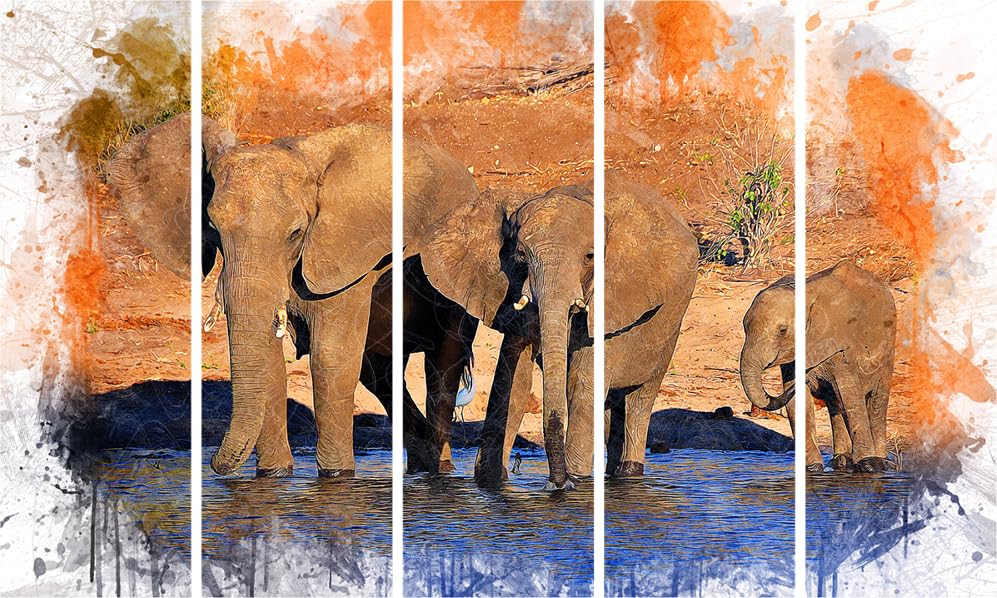
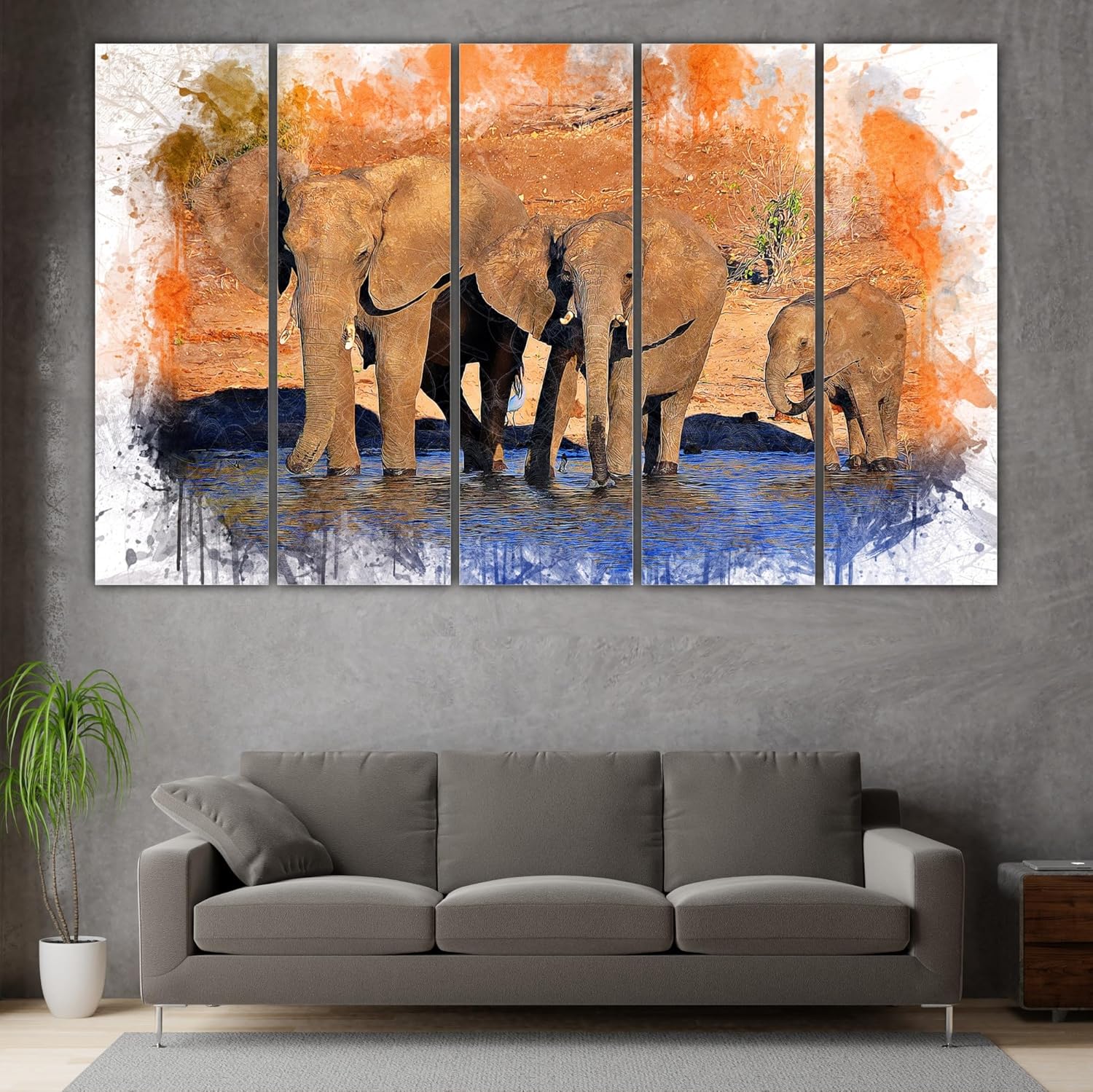
Moolwan 5-Panel Elephant Vinyl Wall Art on MDF (127x76cm) – Photorealistic Wildlife in Watercolor Terracotta and Cobalt Blue
You can picture the wall where this belongs. Probably behind your sofa, 10 to 12 feet wide, cream or off-white like most Indian apartment walls. You've mentally placed art there more than once. The problem isn't knowing you want something there—it's knowing whether this specific 127cm will read right from your doorway. Whether five panels that look proportional in styled photos will hold up against your actual furniture arrangement, your floor lamp, your side table, the window 4 feet to the left.
Here's what 127cm actually looks like on that wall: on a 12-foot (360cm) span, it covers 35%—leaving roughly 116cm of breathing room on each side. Above a standard 6 to 8-foot sofa, it sits wide enough to anchor the furniture zone without crowding the edges. The elephant family moves left to right across five panels, each approximately 24cm wide, creating a horizontal rhythm that makes the wall read wider than it is. At 76cm tall, it clears 8-foot ceilings comfortably—neither cramped at the top nor leaving awkward empty space between artwork and ceiling line.
The loose watercolor washes—terracotta and burnt orange dissolving into white edges—soften the visual weight. This doesn't announce itself as a heavy statement piece. It settles into the room.
The Visual Math: How 127cm Fits 10–12 Ft Living Room Walls
On a 12-foot (360cm) wall: 35% coverage, 116cm on each side. From the doorway—typically 10 to 12 feet away—this reads as a balanced focal point. Present enough to anchor the sofa zone, contained enough that side furniture breathes.
On a 10-foot (300cm) wall: 42% coverage. This is the upper boundary. Still works if your wall is mostly blank. But if you have a window or doorframe within 3 feet of the sofa edge, the panels may feel tight. Measure before committing.
If you go with 90cm instead: 25% coverage on a 12-foot wall. You'll have 135cm of empty space on each side. The art reads as an accent piece, not a focal point—and your eye will keep registering all that empty wall. It's the right size for bedrooms or walls under 10 feet. In a standard living room, it creates a gap that invites companion pieces.
If you go with 150cm instead: 42% on a 12-foot wall. Works in rooms with genuinely large blank walls. If you have side furniture, a floor lamp, or windows within 3 feet of sofa edges, the 150cm creates spatial tension. 127cm avoids that entirely.
For the five-panel format: panels sit with narrow gaps between them, roughly 3–5mm. These gaps are part of the visual logic—they add rhythm and prevent the piece from reading as one heavy block of color. From normal viewing distance, the gaps are barely perceptible. Up close, they let the composition breathe. The panels don't need to touch to read as one continuous image; the eye completes the connection.
Hanging height: 20–25cm above your sofa's top cushion edge places the canvas center at approximately 145–160cm from the floor—the visual sweet spot from seated height. Mark this with removable painter's tape first. Stand back from your doorway and check: does it feel anchored to the sofa, or floating above it?
What These Colors Look Like on Cream Walls (Morning vs LED)
The palette here is specific: warm terracotta and burnt orange watercolor washes in the background, sandy golden-brown on the elephants with visible skin texture detail, deep cobalt blue along the water base, white and cream edge fades with watercolor splatter. That's the full range. What it does in your home depends on your light source.
In morning light (east-facing rooms): The terracotta reads cooler, more golden. The cobalt blue holds depth. The watercolor edges lighten toward white. The effect is calm and naturalistic—a good quality in rooms used for morning routines.
In afternoon light: Orange and terracotta saturate. The piece looks closest to product images—warm and vivid, but not harsh, because the watercolor technique absorbs light rather than reflecting it sharply. Eco-solvent inks on vinyl are UV-stable; dye-based inks shift toward orange-pink within six months of afternoon sun exposure on the same wall. These won't.
In evening warm LED light (3000K, standard in most Indian homes): Colors deepen. The cobalt blue becomes richer against the terracotta glow. This is when guests typically see your living room, and this is when the contrast between warm background and cool water registers most clearly. Each panel edge casts a subtle shadow in directional LED light, adding dimensionality to the surface.
Against cream or off-white walls: Nothing in this palette competes with a neutral wall. The warm tones complement without clashing. Against light yellow walls (builder-grade shade): the terracotta and sandy tones blend naturally with warm undertones. Against cool gray or stark white walls: the palette may feel slightly disconnected—this composition is built for warm-neutral environments.
With brown or beige sofas and wooden furniture: the sandy elephant tones echo your furniture. The terracotta introduces warmth without introducing a foreign color family. The cobalt blue provides enough contrast to prevent the piece from dissolving entirely into a brown palette.
Rental-Friendly Mounting: How to Hang Five Panels Without Losing Your Deposit
Each panel hangs independently on pre-attached D-ring hangers. The paper hanging template marks the exact horizontal position and height for all five panels in one step—you're not measuring panel-by-panel and hoping they align. Tape the template to your wall, use a spirit level on the template, mark all drill points, remove, drill, hang.
Holes required: 2 anchor points per panel, 5 panels, 10 holes total. All 6mm diameter, 30–35mm deep. Concrete walls (older Indian buildings): use included concrete anchors. Drywall (newer apartments): use included drywall anchors. Tap your wall to confirm—hollow sound is drywall, solid sound is concrete. Both types are included.
The panel alignment question is valid, and the template is the answer. You're establishing one horizontal reference line across all five panels before drilling a single hole. If the template is level, the panels are level. That 30 seconds of checking prevents the drift—2 to 3mm across the full width—that becomes visually obvious once panels are up.
For renters: 10 small holes, filled with standard wall putty (₹50 at any hardware store), sanded smooth, touched up with leftover wall paint. Total repair cost under ₹300. A landlord doing a routine walk-through won't notice. These holes are smaller than the ones left by curtain rod installation.
Weight per panel: approximately 600g. Two anchor points per panel handle this easily. You're not dealing with the wall load of a TV bracket or shelving. Standard anchors in Indian concrete and drywall support this without issue long-term.
The Honest Difference Between This and Macrame Wall Hangings
Macrame appears in the same search results at similar price points, positioned as a handmade alternative to printed art. The comparison is worth making directly.
Macrame hangs from a single rod and drapes downward. The visual weight is top-heavy with no defined lower boundary. In Indian homes with 8-foot ceilings, a 70–90cm drop of woven cotton occupies significant vertical space but never reads as a grounded focal point—it reads as hanging, not placed. This suits certain aesthetics, but in most Indian living rooms with warm neutrals and wooden furniture, it lacks visual resolution.
Texture-wise, macrame stays in the off-white to cream range. It doesn't introduce color. Against cream walls, it reads as decorative texture without visual distinction. This elephant piece introduces a specific palette—terracotta, cobalt blue, sandy warm brown—that exists nowhere else in a typical living room. The contrast is what makes it register.
Longevity: macrame cotton collects dust in the open weave. In cities with high particulate air, it needs regular washing and reshaping. The vinyl surface on MDF here is dustable with a dry cloth, sealed at the edges, and requires no maintenance beyond periodic wiping.
On the guest-approval dimension: macrame reads as a trend. It will date. A watercolor wildlife composition reads as art, not trend—which is why it tends to outlast family scrutiny across visits.
Morning Light vs. Evening LED: How This Looks Throughout the Day
From the doorway (10–12 feet): You see the complete family—adults and calf, moving through water, terracotta washes framing the scene on each side. The five-panel rhythm reads as horizontal movement. Your eye travels left to right. At this distance, the panel gaps are invisible and the piece functions as a single panoramic.
From close range (2–3 feet): The technical detail surfaces. The elephant skin shows fine tonal variation, wrinkle rendering, the way light catches near the tusks. The watercolor washes have visible brushstroke edges. The cobalt water has layering. This is a piece that rewards attention, not just fills wall space.
Does it dominate the room? At 127cm on a 12-foot wall above a standard sofa, it anchors without dominating. The warm tones integrate with the typical Indian living room palette rather than demanding constant visual attention. It will become part of the room's baseline—which is what sustained wall art should do.
As a standalone composition: the five-panel panoramic format is designed to work alone. A narrow side table with a small plant or floor lamp coexisting alongside it is fine. A second large wall art piece flanking it creates competition for the same visual zone.
One honest condition: if your living room has strong accent colors—deep navy cushions, burgundy curtains, forest green rugs—the terracotta background may feel at odds. This palette is built for warm-neutral rooms. It's not universally compatible with all color schemes.
Moolwan Design Note
The five panels are sequenced so the elephant family's left-to-right movement reads as continuous forward motion. The watercolor edge fades on panels 1 and 5 create natural entry and exit points, preventing the panoramic from feeling cut off at the borders—the composition resolves itself rather than ending abruptly.
Moolwan Quality Standard
Designed for Indian apartments and lighting conditions. Printed to resist humidity-related color fading. Packed for long-distance Indian transit. Quality checked before dispatch. Ships from West Bengal.
Moolwan Fit Guidance for Indian Homes
At 127cm wide across five panels, this is proportioned for the 10 to 12-foot walls found in standard Indian 2BHK and 3BHK living rooms, mounted 20–25cm above a 6 to 8-foot sofa for correct visual anchoring.
Quick Specifications
- Product: Moolwan 5-Panel Elephant Vinyl Wall Art on MDF (127x76cm)
- Brand: Moolwan
- Category: Vinyl Wall Art on MDF
- Collection: Animal Wall Art Collection
- Dimensions: 127cm W × 76cm H × 0.6cm D (per panel)
- Weight: 3kg (all 5 panels)
- Material & Construction: Splash-proof vinyl print on MDF
- Colors: Warm terracotta, burnt orange, sandy golden-brown, cobalt blue, cream-white watercolor edges
- Best For: 10–12 ft living room walls, above 6–8 ft sofas
- Ships From: West Bengal
- Price: ₹2,496
Frequently Asked Questions
Will 127cm look proportional on my 10-foot wall?
On a 10-foot (300cm) wall, 127cm covers 42% of the width—toward the upper boundary. It works if your wall is mostly open. If you have a window or doorframe within 3 feet of the sofa edge, measure that clearance before buying. On a 12-foot wall, 35% coverage is the balanced range for most Indian living rooms.
How do the terracotta and orange tones behave under evening LED light?
Under warm white LED (3000K, which is standard in most Indian homes), the terracotta deepens and the cobalt blue becomes richer. The contrast between warm background and cool water registers most clearly in evening light. Colors stay consistent because eco-solvent inks on vinyl hold under UV; dye-based alternatives shift toward pale orange-pink over time under similar conditions.
Do all 5 panels mount separately, or is there a combined hanging system?
Each panel hangs independently on pre-attached D-ring hangers. The included paper template marks all five panel positions simultaneously from one horizontal reference line. You mark all drill points at once before drilling anything. Two anchor points per panel, 10 total holes, all 6mm diameter.
Will the MDF panels warp through monsoon humidity in Mumbai or Chennai?
The vinyl print surface is splash-proof and panel edges are sealed. Surface moisture doesn't penetrate the print. For rooms with extreme condensation from unsealed windows directly adjacent to the wall (common in some coastal apartments), ensure the wall surface itself is dry before installation—the panels are sealed, but moisture absorbed into the wall behind them over time can affect any mounted piece.
How do I keep all five panels perfectly level without a second person?
Tape the hanging template to the wall and level the template—not the panels—using a spirit level. Mark all drill points through the template before drilling. This sets a single correct horizontal reference for all five panels at once. Individual panels hang level automatically when the reference line is accurate. Attempting to level panel-by-panel without a template is what causes visible drift.
Product Snapshot
- Brand: Moolwan
- Product: Moolwan 5-Panel Elephant Vinyl Wall Art on MDF (127x76cm)
- Category: Vinyl Wall Art on MDF
- Collection: Animal Wall Art Collection
- Theme/Type: Elephant family, watercolor-meets-photorealistic wildlife
- Best For: 10–12 ft living room walls above standard Indian sofas; warm-neutral room palettes
- Primary Differentiator: Photorealistic elephant skin detail rendered within loose watercolor terracotta washes—fine art texture combined with painterly composition
- Secondary Differentiators: (1) Left-to-right family movement creates horizontal flow that visually widens the room across five panels; (2) Terracotta-cobalt blue contrast integrates naturally with Indian cream walls and brown wooden furniture
- Material & Construction: Splash-proof vinyl print on MDF
- Care Instructions: Dust with dry microfiber cloth; no water, no chemical cleaners
- Ships From: West Bengal
- Packing: Long-distance transit ready
- Quality Check: Before dispatch
- Price: ₹2,496