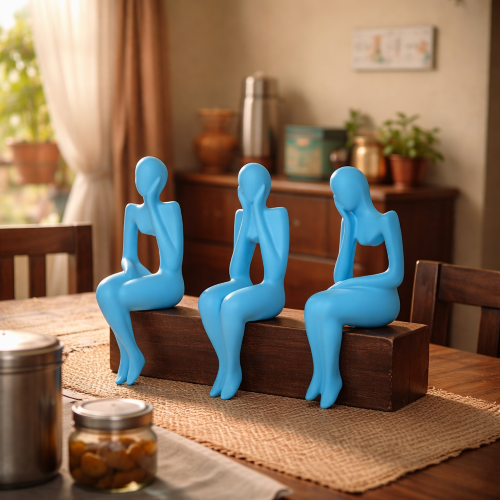
The single biggest mistake in small rooms is adding too many pieces. A modern sitting room in a compact Indian apartment needs a focal point — not five accents competing for attention. Choose one dominant wall element (a canvas or a wall hanging), one surface display (a vase, statue, or sculptural showpiece), and let negative space do the rest. Restraint is what makes a room look designed, not decorated.
Scale is the most overlooked variable in small-room décor. A showpiece that looks right on a website can overwhelm a 2-foot shelf the moment it arrives. Moolwan uses a three-tier sizing framework that maps directly to the surfaces in Indian homes:
| Size Tier | Height Range | Weight Range | Ideal Placement in Small Rooms | Best For |
|---|---|---|---|---|
| Small | 10–16 cm | 150–250 g | Floating shelf, bathroom counter, study desk | Accent clusters, trio arrangements |
| Medium | 16–21 cm | 250–400 g | Showcase cabinet, coffee table, console table | Solo statement piece or paired display |
| Large | 25–34 cm | 400–600 g | Floor corner, TV unit centrepiece | Single focal point — use alone |
For a small sitting room, the medium tier (16–21 cm) is usually the sweet spot for a coffee table or showcase. If your shelf is narrow — under 25 cm deep — stay in the small tier and arrange 2–3 pieces in a staggered height group. Avoid placing a large-tier piece in a room under 150 sq ft; it reads as furniture, not décor.
Browse Moolwan's modern home décor collection — every piece is tagged by size tier so you can filter before you browse.
In a compact room, a single well-chosen canvas does more work than any furniture rearrangement. The instinct to "fill" walls creates visual noise that makes rooms feel smaller. One canvas on your longest wall — sized to at least one-third of the wall's width — creates depth and draws the eye, which tricks perception into reading the room as larger.
Indian homes deal with humidity, seasonal temperature swings, and dust — conditions that destroy poorly made canvas art within months. Moolwan's canvas wall art is printed on 340 GSM cotton canvas with eco-solvent UV-resistant inks, mounted on 1.5-inch kiln-dried pine frames with a moisture-resistant coating. This combination handles Indian monsoons and summer heat without warping, fading, or peeling — a standard most imported canvases do not meet.
For a small sitting room, choose a horizontal canvas over a vertical one. Horizontal lines expand perceived width. Stick to a palette that echoes at least one colour already in your room — a sofa cushion, a rug thread, the trim of your curtains. This creates cohesion rather than contrast overload.
Explore Moolwan's luxury décor range for contemporary room styling — including wall hangings and vases sized for Indian apartments.
A small sitting room can carry one to three showpieces. Beyond that, you're collecting, not decorating. The material of your showpiece affects both the look and the longevity — particularly in Indian climate conditions.
Moolwan's ceramic figurines and vases use a 92% clay composition, are heat-resistant up to 60°C, and tolerate humidity up to 85% RH — which covers the hardest months in coastal and monsoon-heavy Indian cities. They are rated for a 5+ year lifespan under normal indoor use, and the glaze finish makes them easy to wipe clean. These suit showcase cabinets, TV unit tops, and console table displays equally well.
Resin pieces at Moolwan use 94% purity epoxy resin with a 3H pencil hardness scratch-resistance rating. They maintain structural integrity in temperatures between 15–35°C and humidity up to 60% RH. Their lighter weight — often under 300 g — makes them safe for floating shelves and older wooden furniture that can't bear heavy ceramics.
If your sitting room has both a coffee table and a floating shelf, place the ceramic piece on the more stable surface (coffee table) and the resin piece on the shelf. This is not just aesthetic logic — it's structural common sense.
For rooms that still carry some traditional Indian character — wooden furniture, brass accents, jharokha-style windows — consider anchoring the modern look with one traditional-inspired piece. Moolwan's traditional décor collection includes showpieces, wall hangings, and vases that bridge both aesthetics without looking like a mismatch.
Layering is what separates a designed room from a decorated one. In a small space, layering must be controlled. Follow this sequence:
A common mistake in Indian sitting rooms is filling every surface because it "feels incomplete." Modern Indian interior design has shifted decisively toward curated minimalism — fewer, better pieces that carry cultural weight without creating visual noise.
| Property | Ceramic Showpiece | Resin Showpiece | Canvas Wall Art |
|---|---|---|---|
| Weight | 250–600 g | 150–350 g | 400–600 g (framed) |
| Heat tolerance | Up to 60°C | 15–35°C (indoor) | UV-resistant inks |
| Humidity tolerance | Up to 85% RH | Up to 60% RH | Moisture-resistant coating |
| Scratch resistance | Glazed surface, moderate | 3H pencil hardness | N/A |
| Lifespan | 5+ years | 3+ years | UV-protected, long-term |
| Best placement (small room) | Coffee table, showcase | Floating shelf, desk | Primary accent wall |
| Maintenance | Wipe with damp cloth | Dry cloth only | Dust with soft brush |
For most Indian sitting rooms under 150 sq ft, the highest-ROI combination is one canvas on the main wall plus one or two medium-tier ceramic or resin showpieces on a single surface. This covers all three dimensions — vertical, surface, and accent — without crowding the room.
For a sitting room under 150 sq ft, use 1 wall element (canvas or hanging) and no more than 3 showpieces across all surfaces. The rule is one display surface — either a coffee table or a showcase shelf, not both loaded at once. Restricting to a single focal surface forces curation and keeps the room from reading as cluttered.
Warm neutrals (ivory, sand, terracotta) and deep jewel tones (forest green, cobalt, burgundy) both work well — the key is limiting your palette to 2–3 colours across all décor pieces. In Indian homes, warm neutrals read as expansive in natural light. A single jewel-toned showpiece against a neutral wall creates contrast without visual chaos.
Yes — and it often looks better than a fully modern or fully traditional room. The rule is to mix materials, not styles. A modern resin sculpture alongside a traditionally designed ceramic vase works because the material contrast is intentional. What does not work is mixing both styles on every surface — pick one surface for this intentional contrast and keep others uniform.
Moolwan accepts returns within 24 hours of delivery, provided the item is unused and in original packaging. A 10% restocking fee applies. Refunds are processed within 15 working days. This policy covers all showpieces, canvas wall art, and gifting items purchased directly from Moolwan.com.
Moolwan's ceramic showpieces tolerate humidity up to 85% RH, and canvas art carries a moisture-resistant coating on 340 GSM cotton canvas — both engineered specifically for Indian climate conditions. Resin pieces are best suited to rooms with humidity under 60% RH; avoid placing them in coastal or ground-floor rooms during peak monsoon months without climate control.
Every Moolwan piece is manufacturer-direct — no middlemen, no retail markup. Climate-engineered for Indian homes. Pan-India free shipping. Cash on delivery available.
→ Shop Modern Home Décor
→ Explore Luxury Showpieces & Room Styling
→ Browse Traditional Décor for Indian Living Rooms
Quick View