
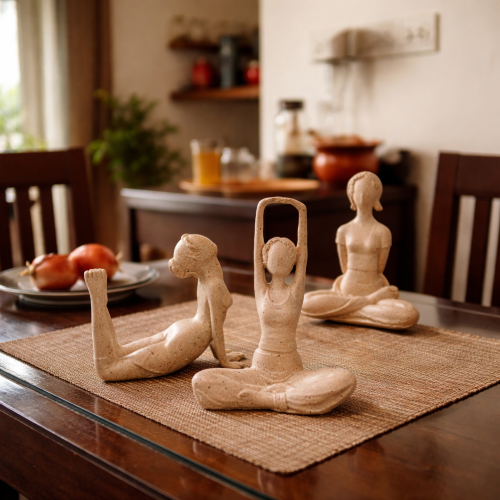
How Do You Make Your Home Look Elegant?
An Indian home looks elegant when each room follows a 3-layer structure — a neutral foundation, one tonal accent layer, and a single focal statement piece — with at least 60% of every surface left clear. Elegance is a ratio problem, not a shopping problem: fewer, better-made pieces outperform a room full of small trinkets.
We help design-conscious Indian homeowners turn cluttered, mismatched rooms into spaces that feel intentional and elevated, without hiring an interior designer. The fastest lever is restraint: a living room with one large modern home decor piece and two supporting accents reads as elegant in a way that ten small items never will, because the eye has a single, clear place to land.
Why Most Indian Homes Look Busy Instead of Elegant
Elegance fails in most Indian homes for one structural reason: too many small decorative objects compete for attention at the same visual height. A shelf with six curios of similar size creates visual noise, while a shelf with one 25–34cm focal showpiece and two smaller 10–16cm accents creates hierarchy — and hierarchy is what the eye reads as "designed" rather than "collected."
The second failure point is material mismatch. Rooms that mix low-cost, mass-produced resin with premium ceramic or canvas pieces look uneven even when the layout is correct, because sheen, texture, and finish quality don't align. Moolwan manufactures in-house across ceramic, resin, and canvas categories specifically so finish quality stays consistent whether a piece is used as a focal point or a supporting accent.
The third failure point is climate damage that homeowners mistake for a styling problem. Décor that warps, yellows, or develops surface bloom within a year in humid coastal cities or dry inland heat will always look "off," regardless of arrangement. This is a materials issue, not a taste issue — and it's the one most home décor guides skip entirely.
Moolwan's 3-Layer Elegance Formula
The 70/20/10 split matters because it forces a decision hierarchy: buy one focal piece, then let everything else stay secondary. Homeowners looking for that one anchor piece can buy a showpiece for home decor sized specifically as a focal point rather than adding another small object to an already full shelf.
Choosing Materials That Actually Hold Their Elegance in Indian Climates
Elegant décor has to survive Indian humidity and heat, or it stops looking elegant within a season. Each material category has a different tolerance threshold, and matching the material to the room's climate exposure is what separates décor that ages well from décor that needs replacing every year.
Ceramic showpieces at Moolwan use a 92% clay composition, are heat-resistant to 60°C, and tolerate humidity up to 85% RH — making them the safest focal-point choice for kitchens, balconies, and coastal-city homes. Resin sculptures use 94%-purity epoxy resin with 3H pencil-hardness scratch resistance, but are rated for a narrower 60% RH and 15–35°C range, so they perform best in climate-controlled living rooms and bedrooms rather than open verandas. Canvas wall art is built on 340 GSM cotton canvas with eco-solvent UV-resistant inks and a moisture-resistant coating over 1.5-inch kiln-dried pine frames, which is why it holds color and shape even in sun-facing rooms where cheaper prints fade within months.
| Material | Best Use | Humidity Tolerance | Lifespan | Finish |
|---|---|---|---|---|
| Ceramic Showpiece | Focal point, kitchen, balcony, humid regions | Up to 85% RH | 5+ years | Matte or glazed |
| Resin Sculpture | Living room, bedroom, climate-controlled spaces | Up to 60% RH | 3+ years indoor | Matte or glazed |
| Canvas Wall Art | Sun-facing walls, living rooms, entryways | Moisture-resistant coating | Multi-year, UV-stable | Matte finish print |
For most Indian living rooms, the practical rule is: canvas or ceramic for the focal piece, resin reserved for indoor accent pieces away from direct heat or open windows. Explore unique decor items for an elegant living room and the best home interiors to match a piece's material rating to your room's actual exposure before buying.
Ready to apply the 3-Layer Formula to your own space?
Shop Modern Home Decor →Sizing and Placement Rules for an Elegant Finish
Size mismatch is the most common reason a "good" piece still looks wrong in a room. Moolwan's size bands exist specifically to remove this guesswork: Small (10–16cm) pieces belong on shelves, desks, or bathroom counters as accent-layer items; Medium (16–21cm) pieces work on showcases and coffee tables as secondary anchors; Large (25–34cm) pieces are built to be the room's single focal point, typically on a console table, TV unit, or entryway console.
- Coffee tables: one Medium (16–21cm) piece, never two Large pieces side by side.
- Entryway consoles: one Large (25–34cm) focal piece plus a single canvas wall art above it — nothing else on that surface.
- Open shelving: alternate one Small and one Medium piece per shelf, leaving at least 60% of shelf depth visibly empty.
- Bedside tables: Small pieces only (150g–350g) — anything heavier reads as clutter next to a lamp and books.
Weight matters as much as height for Indian walls and shelving, most of which aren't built for heavy ornamentation. Moolwan's décor range stays between 150g and 600g across categories, which keeps focal pieces safe on lightweight brackets and rented-home wall fittings without needing structural reinforcement.
How to Layer Traditional and Modern Décor Without Losing Elegance
The tension every design-conscious Indian homeowner navigates is balancing modern minimalism with pieces that still feel culturally rooted — a home that's too minimal reads as cold, while one that's too traditional can read as cluttered. The fix is to let the focal piece carry the cultural weight and keep the accent layer strictly modern and neutral.
A traditional-motif ceramic showpiece or a canvas piece with an Indian art influence works as the single focal point in an otherwise clean, modern room. Once that focal piece is set, resist adding more traditional accents — the accent layer should stay in matte neutrals so the focal piece doesn't have to compete for cultural "read." This single-focal-point rule is what makes fusion interiors look curated instead of themed.
What Ruchi Malhotra says about this balance
"Indian homeowners don't have to choose between modern and traditional — they have to choose which one leads. Let one piece do the cultural storytelling, and let everything else in the room support it quietly," says Ruchi Malhotra, Founder & CEO of Moolwan (Euphorica Ventures Pvt Ltd), Bangalore.
Find the one focal piece that anchors your room's story.
Browse Unique Decor Items →Frequently Asked Questions
What is the fastest way to make a living room look elegant?
Remove every decorative object except one, then reintroduce a single Large (25–34cm) focal piece and no more than two Small accent pieces. This alone corrects the most common elegance mistake: too many objects competing for attention at once.
How many decor pieces are too many for an elegant look?
As a working rule, no more than three décor objects per visible surface — one focal piece and two accents — with at least 60% of the surface left visually clear. Beyond three objects, a shelf or table starts reading as storage rather than styling.
Do matte or glossy finishes look more elegant in Indian homes?
Matte finishes generally photograph and read as more elegant in bright, sunlit Indian interiors because they don't create glare, while glazed finishes work best as accent pieces under focused lighting. Moolwan offers both across ceramic and resin categories, so the finish can be matched to the room's natural light.
What size showpiece works best for a coffee table?
A Medium showpiece (16–21cm) is the correct scale for most Indian coffee tables — large enough to act as a secondary anchor, but not so large that it interferes with everyday use of the table.
How do you stop humidity from damaging home decor in Indian homes?
Match the material to the room's humidity exposure: ceramic (rated up to 85% RH) for kitchens, bathrooms, and coastal-city homes, and resin (rated up to 60% RH) only for climate-controlled indoor spaces. Using resin in high-humidity rooms is the single biggest cause of premature décor damage in Indian households.
Build your room's 3-Layer Elegance Formula today — focal piece, accents, and finish, all in one place.
Shop Showpieces for Home Decor →


