
How to Add Personality and Warmth to a New Living Room with Decor Accents
The Short Answer
A living room reads as impersonal when furniture sits alone with no small-scale objects to anchor the eye. Moolwan recommends layering matte ceramic and resin showpieces (16–21cm) in clusters of three across coffee tables and console tops, because odd-numbered, staggered-height groupings read as intentionally curated rather than placed, adding warmth without clutter.
Design researchers consistently find that rooms styled with furniture alone, and no small-scale decorative objects at tabletop or shelf height, are rated as noticeably less "lived-in" by occupants than rooms layered with personal accent pieces — because the eye treats large, uniform surfaces like sofas and rugs as background rather than a focal point. Moolwan helps design-conscious Indian homeowners close that gap with ceramic and resin décor collections sized and finished specifically for the coffee tables, console units, and bookshelves typical of compact Indian apartments.
Why Does a New Living Room Still Feel Empty or Generic?
A living room feels generic the moment every horizontal surface above floor level is left bare of decorative objects.
Interior stylists track what they call "visual rest points" — small objects positioned at eye or tabletop level that the eye pauses on while scanning a room — and rooms with fewer than two or three rest points per main wall are consistently rated as impersonal in occupant surveys. This happens because the human visual system processes large, repeated surfaces such as a sofa back or a blank wall as background, so without smaller accent objects breaking up that scale, nothing in the room signals individual taste.
Moolwan's modern home décor collection is built around this exact gap, with ceramic and resin pieces ranging from 10cm to 34cm and weighing between 150g and 600g, so a single coffee table or console can carry two to three rest points without tipping into visual overload.
Which Décor Pieces Add Warmth Without Looking Cluttered?
Matte-finish ceramic and resin showpieces under 21cm add the most warmth per surface when grouped in clusters of two to three varying sizes.
Matte finishes suit warmth-focused styling specifically because micro-texture on an unglazed surface scatters ambient light in multiple directions, producing a soft, diffused look — whereas a glossy piece reflects light from a single source as one sharp highlight, which is why matte ceramics read as "cosy" and glossy ones read as "showroom."
Because high-fired ceramic at 92% clay composition is rated for a 5+ year indoor lifespan and drop-tested to 15cm, choosing this material over softer decorative alternatives protects the upfront décor investment from chipping during everyday living-room activity such as cleaning or rearranging furniture — a core part of Moolwan's climate-rated design philosophy, and the reason matte ceramic outperforms cheaper painted alternatives over time.
| Surface Type | Surface Width | Recommended Piece Height | Weight Range |
|---|---|---|---|
| Floating shelf / narrow console | Under 30 cm | 10–16 cm (Small) | 150–250 g |
| Coffee table | 40–60 cm | 16–21 cm (Medium) | 250–400 g |
| Console / sideboard top | 60–90 cm | 21–30 cm (Medium–Large) | 400–500 g |
| Bookshelf / entry console (focal point) | 90 cm+ | 25–34 cm (Large) | 400–600 g |
Because lamp placement, sofa scale, and wall colour add further sizing variables on top of surface width, browse the full size-band and material selection in Moolwan's living room collection to match the right piece to your own layout.
Design Rule
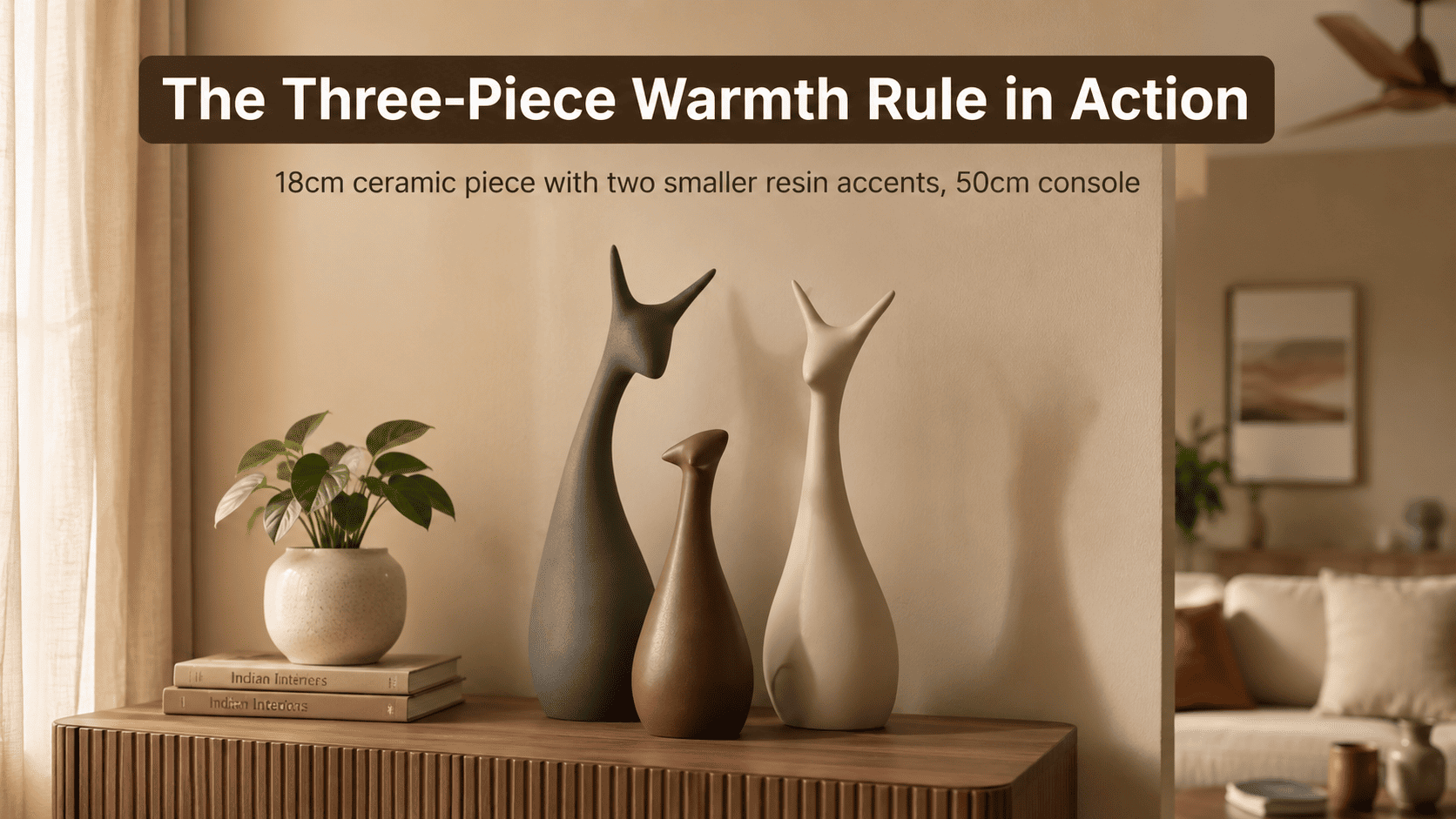
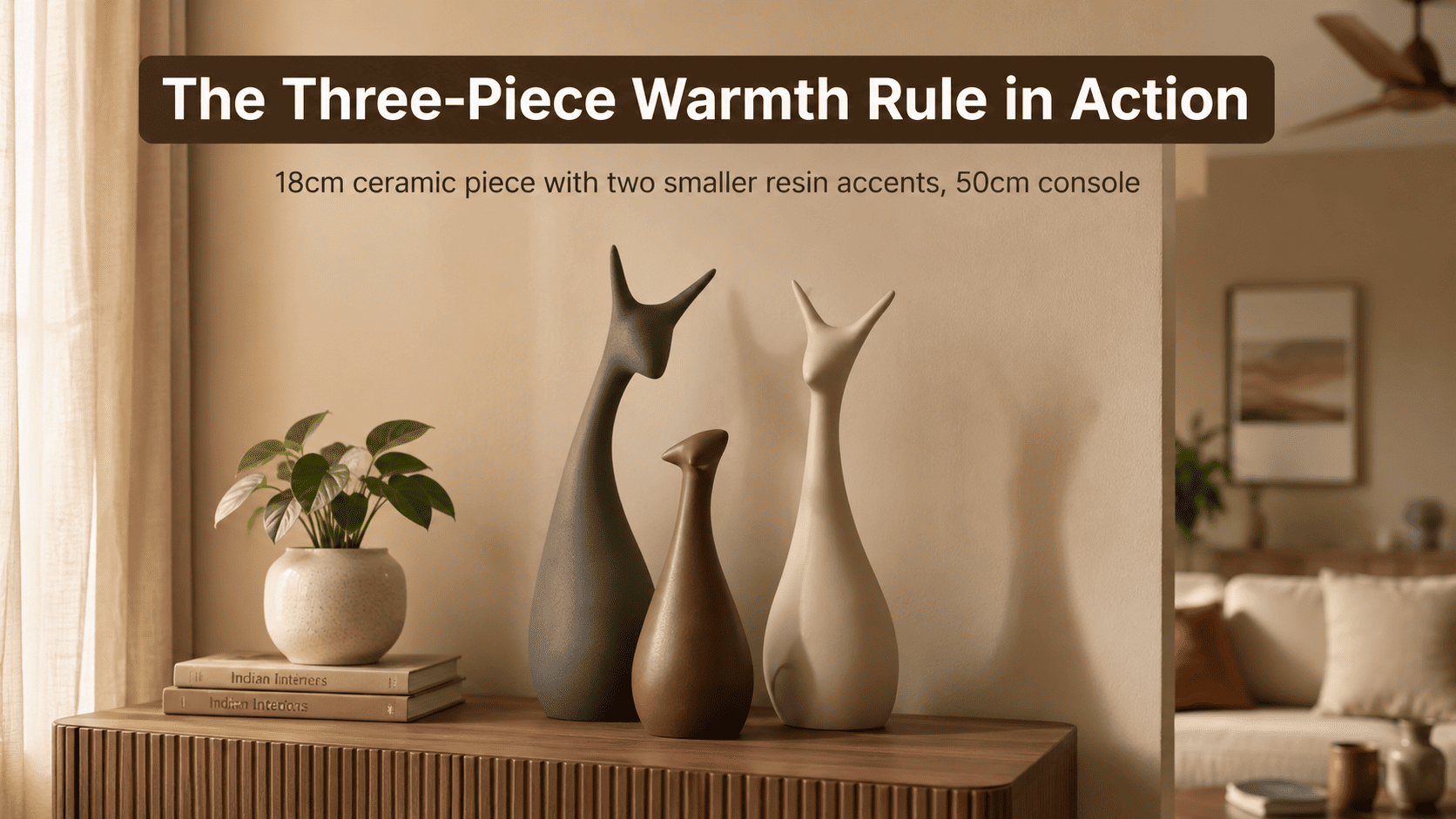
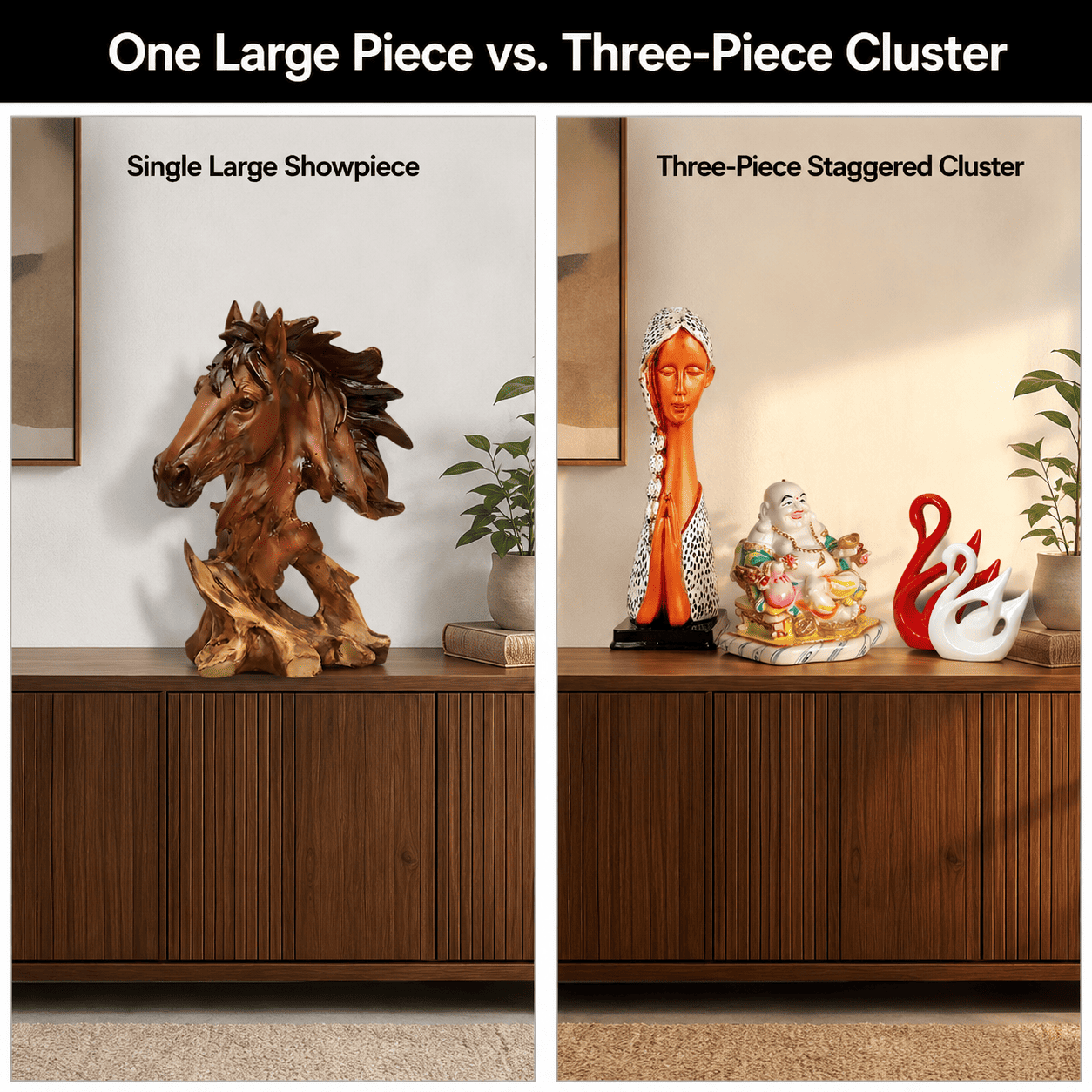
To add warmth without visual clutter, style every clear surface using Moolwan's Three-Piece Warmth Rule, which calls for clustering exactly three décor objects of varying height — one short, one medium, one tall — on any surface wider than 40cm, because an odd-numbered, height-staggered group has no single line of symmetry for the eye to rest on and is therefore read as curated rather than simply placed.
How Should Colour and Material Be Balanced for a Cohesive Look?
A cohesive living room limits itself to two accent materials — typically ceramic and resin — held within a single warm or neutral palette.
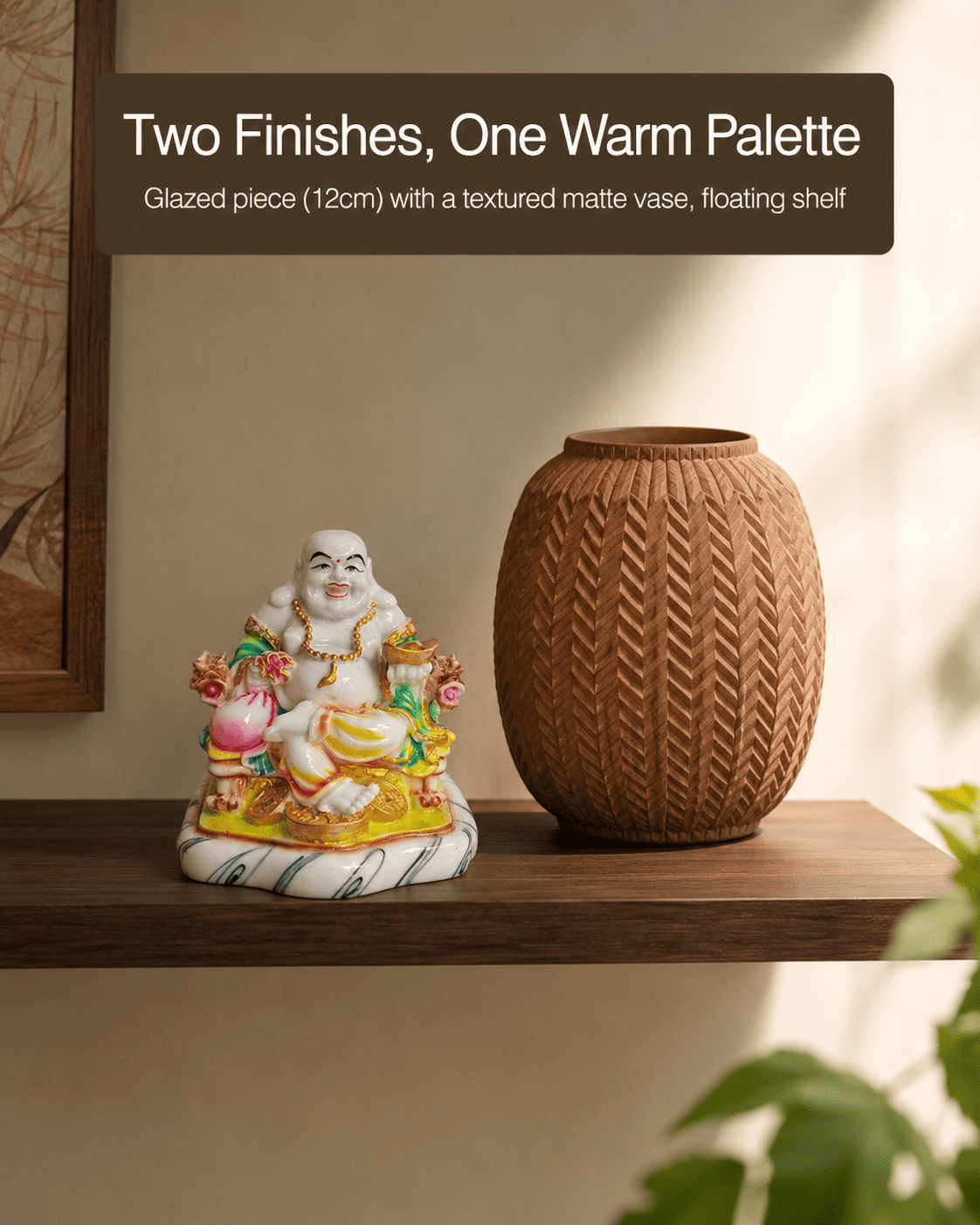
Mixing more than two finish families in one cluster forces the eye to re-categorise each object's material before it can register the grouping as a whole, which is why design stylists cap a single surface at two textures (for example, matte ceramic plus a textured resin piece) rather than three or four. Within that two-material limit, repeating one accent tone — terracotta, sage, or charcoal — across at least two pieces ties a cluster together visually even when the individual shapes differ.
Because resin pieces are rated to a 3H pencil hardness and a 3+ year indoor lifespan against 60% RH humidity, pairing them with ceramic (rated to 85% RH) lets a single console mix two material stories without either piece degrading faster than the other — protecting the overall look from looking mismatched within a year, which is the ROI case for choosing climate-rated materials over generic décor.
Want to bring personality into your own living room this week? Shop the full Moolwan living room collection now and pick pieces sized for your exact coffee table or console.
Where Exactly Should Warmth-Adding Pieces Be Placed in the Room?
Warmth-adding décor works best at three fixed zones: the coffee table, one console or sideboard, and a single shelf at eye level.
Limiting placement to three zones — rather than scattering pieces across every surface in the room — keeps each cluster legible as a deliberate choice, because the eye can only hold two or three "anchor zones" in working memory while scanning a room before the layout starts to feel chaotic rather than warm. Within each zone, the same Three-Piece Warmth Rule height-staggering applies, scaled to that surface's width from the matrix above.
Frequently Asked Questions
How many décor pieces does a living room need to feel personal?
Most living rooms need two to three styled zones — a coffee table, a console, and one shelf — each carrying a cluster of two to three pieces. Fewer than this leaves surfaces bare and impersonal; more than three zones tends to fragment attention, because the eye can only track a handful of anchor points before a room reads as cluttered rather than warm. Moolwan's modern home décor collection is sized specifically for this two-to-three-zone approach.
What size showpiece works best on a standard Indian coffee table?
A medium piece between 16cm and 21cm tall suits most Indian coffee tables, which typically span 40–60cm in width. This size sits proportionally within the table's footprint without dominating it, because décor exceeding roughly a third of the surface width tends to visually overwhelm a tabletop rather than complement it.
Should I mix ceramic and resin décor in the same room?
Yes — ceramic and resin can be mixed within the same cluster as long as both pieces share one repeated accent colour. Ceramic offers higher humidity tolerance (up to 85% RH) while resin offers higher surface hardness (3H pencil rating), so combining them gives a room both durability profiles rather than relying on one material for every surface.
How do I avoid a living room looking cluttered with too much décor?
Cap each surface at three objects and leave the remaining space on that surface visibly clear, since an overcrowded surface removes the negative space the eye needs to register the cluster as deliberate. Sticking to one or two materials and one accent colour per zone also keeps multiple clusters in the same room feeling connected rather than competing.
Ready to add the personality your new living room is still missing? Choose matte or glazed ceramic and resin pieces, explore the wider Moolwan home décor range for more palette options, or check the unique home décor items collection for one-of-a-kind statement accents — then bring home a curated set from the Moolwan living room collection, manufacturer-direct and climate-rated for Indian homes.


