
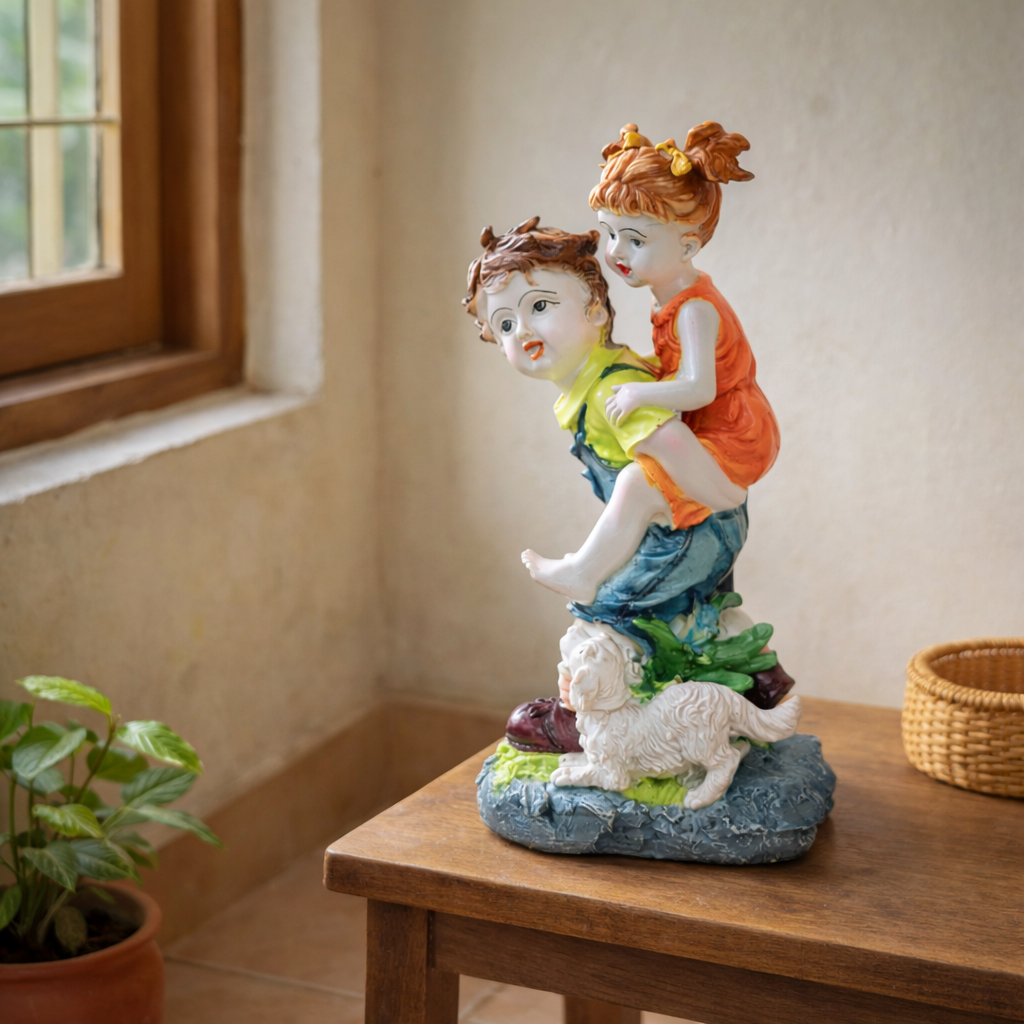
How do I choose the right size and proportion of decor items for a room?
At Moolwan, we help design-conscious Indian homeowners choose decor that fits their actual space — not a showroom floor in Milan. Indian apartments average 600–1,200 sq ft, and most living rooms are between 120–200 sq ft. That scale demands precision in sizing, not guesswork.
The One Rule That Fixes Most Decor Sizing Mistakes
The most reliable sizing principle is the 60–70% rule: a decorative item or arrangement should cover no more than 60–70% of the surface beneath it. A showpiece on a 30 cm shelf should not exceed 18–21 cm in width or height. A centrepiece on a dining table that seats four should span no more than one-third of the table's length.
This rule applies universally — whether you are placing a ceramic figurine, a resin art piece, or a canvas painting on the wall. The remaining negative space around the object is what gives it visual weight. Without that breathing room, even a beautiful piece reads as clutter.
For wall art specifically, the canvas should occupy 57–75% of the available wall width between furniture. On a 5-foot sofa, the ideal canvas width is roughly 3 to 3.5 feet. Moolwan's canvas wall art is crafted on 340 GSM cotton canvas with 1.5-inch kiln-dried pine frames — substantial enough to anchor a wall without warping in India's monsoon humidity.
Decor Size by Room and Surface — A Practical Reference
The right size is not universal — it depends on where the piece lives. This table maps room context to the correct size range, so you can shop with a specific number in mind rather than a vague feeling.
| Placement Location | Recommended Size Range | Moolwan Category | Why It Works |
|---|---|---|---|
| Bookshelf / Study Desk | Small: 10–16 cm | Showpieces & Figurines | Fills space without dominating; works in groups of 3 |
| Coffee Table / Side Table | Medium: 16–21 cm | Showpieces / Decorative Objects | Visible from seating height; proportional to a sofa setting |
| TV Unit / Console | Medium–Large: 18–28 cm | Modern Decor Items | Balances the visual mass of a TV; grounding effect |
| Dining Table Centrepiece | Medium: 16–22 cm height max | Ceramic / Resin Pieces | Low enough to maintain eye contact across the table |
| Entrance / Foyer | Large: 25–34 cm | Statement Showpieces | First impression piece; needs scale to read from doorway |
| Living Room Wall (main) | Canvas: 60–120 cm wide | Canvas Wall Art Paintings | 57–75% of sofa width; eye-level centre at 145–155 cm from floor |
Moolwan's showpieces range from 10 cm to 34 cm, with weights between 150g and 600g — light enough for standard Indian shelving and MDF furniture without structural stress.
Ready to find pieces sized right for your space?
Browse Moolwan's modern home decor items →How Proportion Works Differently in Indian Apartments
Indian urban apartments — especially 2BHK and 3BHK units in cities like Bangalore, Mumbai, Pune, and Delhi — have tighter room proportions than the interiors you see in international décor magazines. Standard ceiling height is 9–10 feet rather than 12 feet. Living rooms are often shared with dining areas. Balconies double as reading nooks.
This matters for decor sizing in three specific ways:
- Vertical proportion: Avoid tall, floor-standing pieces above 50 cm in rooms with low ceilings — they create visual compression. Stick to horizontal groupings on shelves and consoles.
- Grouped arrangements: In a compact space, one Large (25–34 cm) focal piece reads better than three Medium pieces of unequal height. The "odd number rule" — groups of 1, 3, or 5 — prevents visual clutter in tight arrangements.
- Wall art scale in combined living-dining rooms: In open-plan layouts, anchor each zone (seating vs. dining) with a separate art piece rather than one oversized canvas that bridges both — it helps define the zones without physical dividers.
For Indian homes that face monsoon humidity levels between 70–95% RH, Moolwan's ceramic showpieces are rated to 85% RH with a 92% pure clay composition. The resin pieces are rated to 60% RH. Neither material warps, cracks, or dulls under typical Indian climate conditions — which eliminates the size-and-replace cycle common with cheaper imported decor.
The Grouping Formula for Multi-Piece Displays
When placing more than one decor item together — on a shelf, console, or mantle — proportion comes from height variation, not repetition. A display where all pieces are the same height looks like inventory. A display where heights vary by at least 30–40% looks curated.
The Three-Tier Formula
Use one piece at each tier: Tall (anchor, 25–34 cm), Medium (bridge, 16–21 cm), and Small (detail, 10–16 cm). Place them in a loose triangle — the tall piece at the back or one end, the medium adjacent, the small in front or beside. This formula works on TV units, bookshelves, dining sideboards, and entrance consoles in Indian homes.
If you are building this kind of curated shelf display, explore Moolwan's showpieces for the living room — the range is specifically designed with the three-tier formula in mind, with size-matched pairs and trios available.
Negative Space Is Not Wasted Space
Leave at least 20–30% of any shelf or surface empty. In Indian homes where shelves often double as storage, this requires intentional editing. Remove items that do not serve a design purpose. The pieces that remain will carry more visual authority — and the room will feel larger, not emptier.
Sizing for Wall Art: The Most Common Mistake in Indian Homes
The single most common wall art sizing mistake in Indian homes is buying too small. A canvas that feels large in a store or on a phone screen often disappears on a wall once it is hanging. The standard recommendation: your canvas width should be at least half the width of the furniture below it — and ideally 57–75%.
For a sofa that is 180 cm wide, the canvas above it should be between 100–135 cm wide. For a 120 cm console in the entrance, the wall art above it should be 70–90 cm wide. When in doubt, go one size larger than you think you need — and hang it at eye level, with the centre of the canvas at 145–155 cm from the floor.
Moolwan's canvas wall art is printed on 340 GSM cotton canvas with eco-solvent UV-resistant inks and mounted on 1.5-inch kiln-dried pine frames. The moisture-resistant coating means the canvas will not bubble or delaminate in humid Indian rooms — a failure mode common in lower-GSM canvases. For placement inspiration beyond sizing, visit Moolwan's room decoration ideas to see how different canvas sizes work in actual Indian room layouts.
What Moolwan Stands For
Moolwan is a D2C home décor brand manufactured and sold directly to Indian homeowners, without retail markups. The brand sells canvas wall art paintings, modern showpieces, and curated gifts for Indian homes — all engineered for Indian climate conditions, apartment proportions, and long-term durability. Every product is sized, weighted, and finished to fit real Indian living spaces, not aspirational foreign interiors.
Frequently Asked Questions
What is the right size decor item for a 3BHK Indian apartment living room?
For a standard 3BHK living room (roughly 150–200 sq ft), use one Large statement piece (25–34 cm) as a focal point, supported by Medium pieces (16–21 cm) on side surfaces. For wall art, choose a canvas that covers 57–75% of your sofa width — typically 90–130 cm. Moolwan's sizing guide maps each product to a specific room context so you do not have to guess.
How many decor pieces should I put on one shelf?
Limit decorative items to 3–5 per shelf, arranged in the three-tier formula: one tall anchor (25–34 cm), one medium bridge (16–21 cm), one small detail (10–16 cm). Leave 20–30% of the shelf surface empty. Filling every inch creates visual noise, especially in compact Indian apartments where shelves are often at eye level in main living areas.
Can I mix ceramic and resin decor pieces on the same shelf?
Yes — mixing materials adds texture and depth to a display. The key is maintaining size proportion, not material uniformity. Moolwan's ceramic showpieces (92% clay composition, matte or glazed finish) and resin pieces (94% epoxy purity, 3H scratch hardness) are designed with complementary sizing tiers, making them easy to pair without visual conflict.
How high should I hang wall art in an Indian apartment?
Hang the centre of the canvas at 145–155 cm from the floor — this aligns with standing eye level and is the international gallery standard. When hanging above furniture, the bottom of the canvas should be 15–25 cm above the furniture top. In Indian homes with 9-foot ceilings, avoid hanging art near the ceiling line — it visually compresses the room rather than expanding it.
What is Moolwan's return policy if the size doesn't work for my room?
Moolwan accepts returns within 24 hours of delivery, provided the item is unused and in original packaging. A 10% restocking fee applies, and refunds are processed within 15 working days. To avoid returns, use Moolwan's size reference table and the 60–70% proportion rule before ordering.
Find Decor That Fits Your Room — Not Just Your Mood
Every Moolwan piece is sized for Indian rooms, rated for Indian climate, and priced direct from the manufacturer. No middlemen. No guesswork.
Shop showpieces for your living room → Explore room decoration ideas →


