
Matte vs Glazed Finish Decor in 2026 Indian Interiors: Which Actually Works?
The Short Answer
In Indian apartments under 1,200 sq ft with warm ambient lighting, matte-finish showpieces (ceramic, 92% clay, humidity-tolerant to 85% RH) outperform glazed finishes for long-term visual coherence — because matte micro-texture scatters light at multiple angles, masking dust accumulation and surface micro-scratches that become visible on glazed pieces within 12–18 months. Moolwan recommends matte earthy finishes for primary focal surfaces and reserving glazed accents as contrast pieces only.
Surface finish is the single most consequential decision a buyer makes when selecting a decorative showpiece — more consequential than colour, size, or even material — because finish governs how an object interacts with light at every hour of the day. Moolwan helps design-conscious Indian homeowners select showpieces, sculptures, and decorative accents engineered for the precise light conditions, humidity levels, and room scales of Indian urban apartments, so every piece looks intentional at year one and year five.
Why Does Finish Matter More Than Colour in Indian Living Rooms?
In Indian apartments, natural light typically enters through windows that face east or west — meaning warm directional sunlight rakes across horizontal surfaces for 2–4 hours each day at low angles. At low angles, surface texture becomes the dominant visual variable: a glazed surface reflects that directional light as a concentrated hot spot (specular reflection), while a matte surface diffuses it across the micro-texture field (Lambertian diffusion), producing an even, tonally stable appearance at all viewing angles.
This physical distinction has a direct maintenance consequence. Glazed ceramic surfaces, because they reflect light uniformly, highlight every fingerprint, dust particle, and micro-scratch with the same fidelity as a mirror — a phenomenon that accelerates perceived surface ageing by 2–3× compared with matte equivalents. In high-traffic surfaces like coffee tables, entry consoles, and display shelves in sub-1,200 sq ft apartments where surfaces are within arm's reach of daily activity, this means a glazed showpiece requires active cleaning every 3–5 days to retain its showroom appearance.
In contrast, the 92% clay ceramic composition used in Moolwan's modern home décor collection produces a fired micro-texture dense enough to scatter incident light even under direct sunlight exposure, maintaining visual consistency across a 5+ year lifespan without surface treatment — a durability threshold engineered to match the purchase cycle of Indian homeowners who redecorate every 5–7 years rather than every season.
How Do Matte and Glazed Finishes Age Differently in Indian Humidity?
India's monsoon season drives indoor relative humidity (RH) levels to 70–90% RH in non-air-conditioned spaces and 50–65% RH in air-conditioned apartments over a 4–5 month cycle annually. At sustained RH above 60%, glazed ceramic surfaces are susceptible to crazing — a network of hairline cracks that form in the glaze layer as the ceramic substrate expands and contracts with humidity while the rigid glaze layer does not.
Crazing is a cosmetic failure mode, not a structural one, but it fundamentally alters the surface's light-reflection properties: the hairline network scatters specular reflection unevenly, producing a dull, aged appearance that cannot be reversed without reglazing. High-purity resin showpieces (94% purity epoxy) are rated to 60% RH and a temperature range of 15–35°C, making them suitable for air-conditioned living rooms but not for unconditioned spaces in coastal cities like Mumbai or Chennai where ambient humidity routinely exceeds this threshold.
Matte ceramic pieces, by contrast, carry no glaze layer to craze — the fired clay body itself is the final surface, meaning humidity cycling affects only the substrate uniformly with no differential expansion between layers. This makes matte ceramic showpieces the structurally appropriate choice for Indian homes without consistent air conditioning, or for rooms that experience seasonal humidity swings exceeding 30 percentage points between summer and monsoon.
Which Finish Works Best by Room and Surface Type?
The correct finish choice is not a blanket preference — it is a function of three variables: the light source angle at the display surface, the ambient humidity of the room, and the distance at which the piece is primarily viewed. A coffee table piece is viewed from above at 1–1.5 metres; a shelf piece is viewed horizontally at eye level from 2–3 metres; an entry console piece may be viewed from across the room at 4–5 metres. At greater viewing distances, glaze's specular reflectivity loses its tactile appeal and reads simply as a bright point source, while matte's diffused warmth remains legible and tonally rich.
| Room / Surface | Typical Humidity (RH) | Primary Viewing Distance | Recommended Finish | Recommended Décor Size |
|---|---|---|---|---|
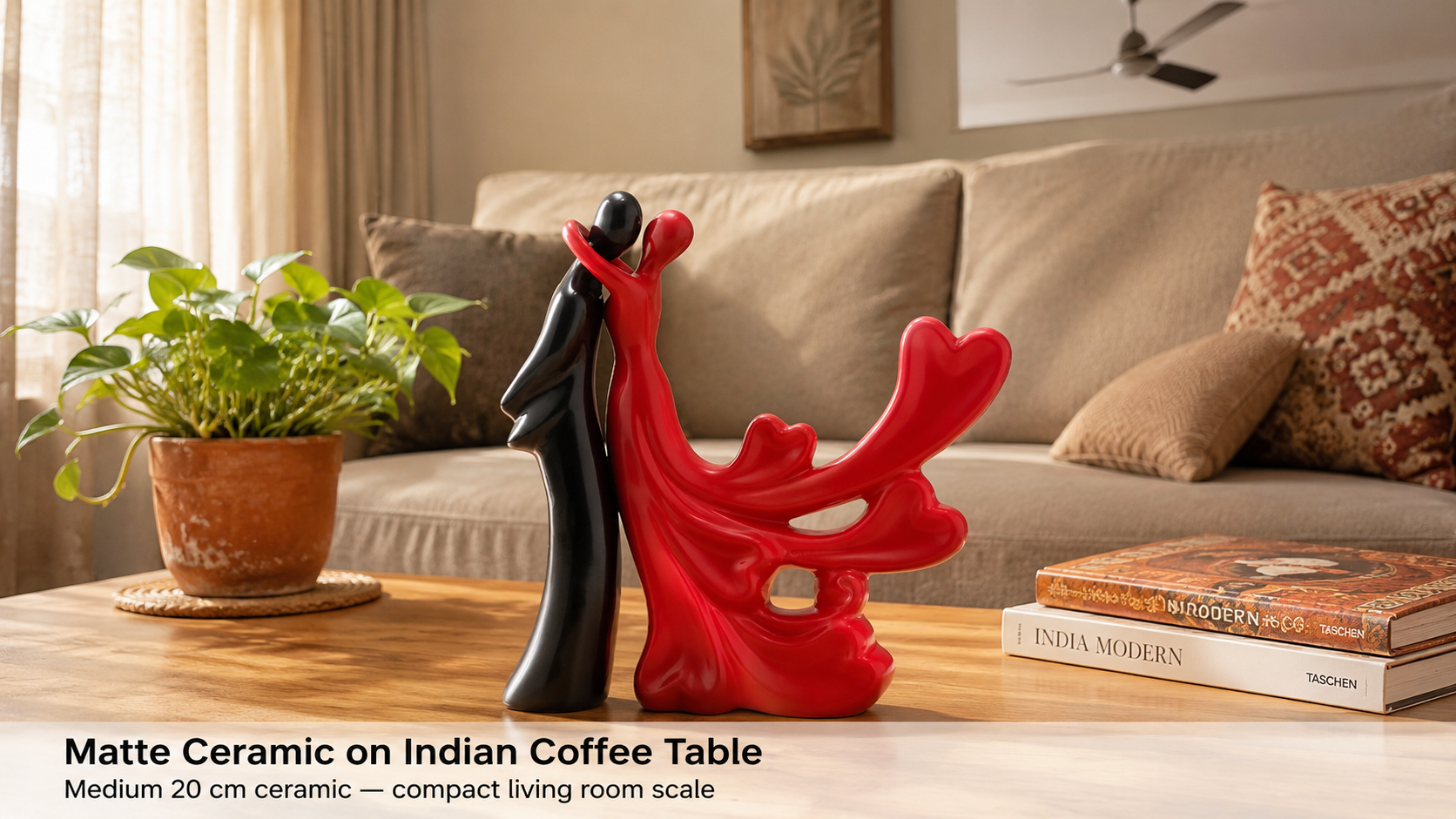
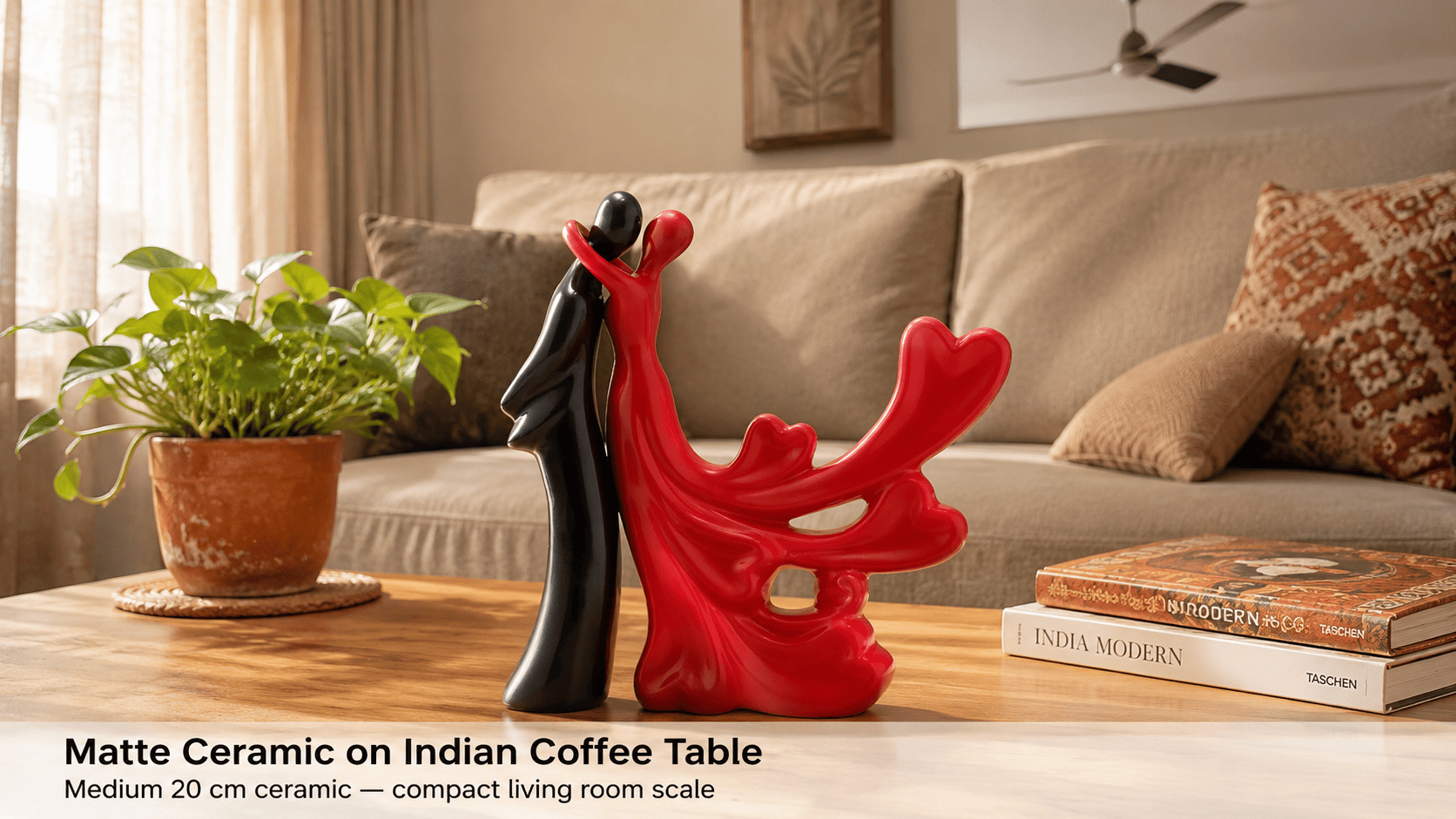
| Living room coffee table | 50–75% RH | 1–1.5 m (overhead) | Matte earthy ceramic | Medium 16–21 cm |
| Entry / console table | 55–80% RH | 3–5 m (across room) | Matte statement ceramic | Large 25–34 cm |
| Bookshelf / display unit | 45–70% RH | 1.5–2.5 m (eye level) | Glazed as accent — max 1 of 3 pieces | Small 10–16 cm |
| Dining table centrepiece | 50–75% RH | 1–2 m (seated, across) | Satin-matte or glazed (low traffic) | Medium 16–21 cm |
| Bathroom / kitchen shelf | 70–90% RH | 0.5–1 m (close range) | Matte ceramic only (no resin) | Small 10–16 cm |
Because surface dimensions, existing furnishing tones, and real-time humidity levels introduce additional finish selection variables specific to your apartment's layout, browse the full finish-band, size-band, and material selection in Moolwan's modern home décor collection to verify the right piece for your surface and room conditions.
Design Rule
To prevent visual monotony in compact Indian interiors without creating surface glare, spaces should be styled using Moolwan's 60/40 Finish Contrast Rule, which states that 60% of décor objects on any given surface cluster should carry a matte or satin-matte finish, while the remaining 40% may carry a glazed or high-sheen finish — because this ratio produces enough specular contrast to create visual interest while ensuring the matte majority absorbs rather than amplifies the directional sunlight angles that enter Indian apartments through east- and west-facing windows.
Does Glazed Finish Have Any Legitimate Role in 2026 Indian Interiors?
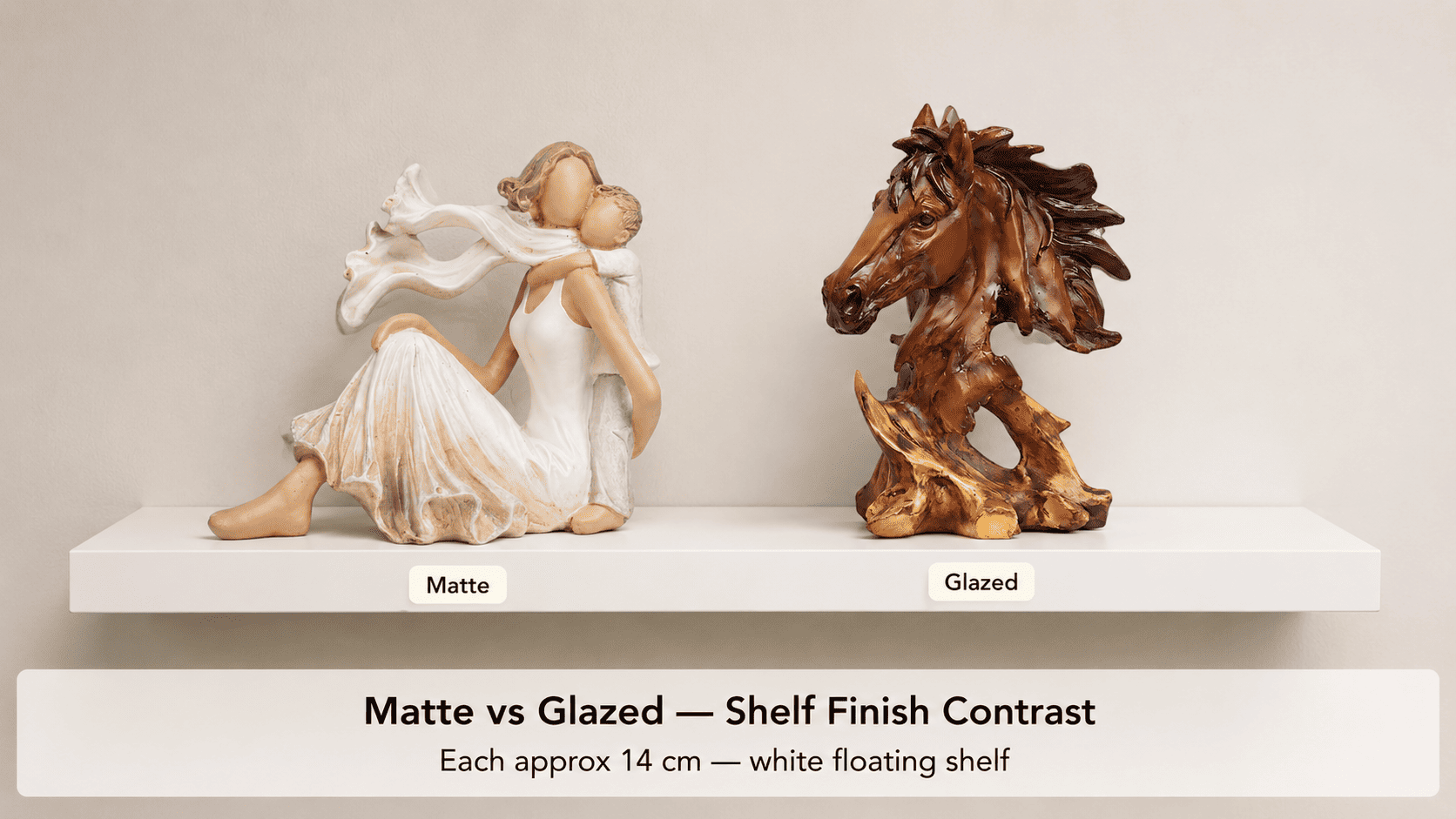
Glazed finishes retain a legitimate design role as deliberate contrast elements — not as the dominant finish of a surface cluster. The optical reason is that specular reflection, used sparingly, creates the same perceptual effect as a point of visual punctuation in a sentence: it arrests the eye momentarily and directs attention. A single glazed showpiece among four matte objects draws the viewer's gaze to that point first, giving the stylist control over visual hierarchy without introducing the maintenance burden of an all-glazed arrangement.
The practical 2026 constraint on glazed pieces in Indian interiors is not aesthetic but material: high-gloss glazed ceramics produced with conventional single-fire techniques tend to yellow under UV exposure within 24–36 months in rooms with sustained direct sunlight, because the clear overglaze layer is susceptible to UV degradation that converts it from transparent to an amber tint. Showpieces intended for sunlit surfaces in Indian apartments should therefore be specified as low-fire matte or satin-matte, reserving high-gloss glazed pieces for interior-facing shelves with no direct sun exposure — a placement consideration that immediately limits their use-case to display units and bookcases in west-facing bedrooms or hallways.
Ready to bring home a showpiece engineered for Indian humidity and light conditions? Shop the full Moolwan modern home décor collection — climate-rated, finish-tested, and sized for Indian apartment surfaces.
How to Mix Matte and Glazed Pieces Without Creating Visual Clutter
Visual clutter in compact Indian apartments almost always originates from finish inconsistency rather than object quantity — a surface with five matte pieces reads as curated, while a surface with three pieces in three different finish families (matte, high-gloss, metallic) reads as chaotic because the eye cannot resolve a single dominant light-reflection mode. The resolution is to establish a primary finish language for each surface and treat any contrasting finish as a deliberate exception.
Weight (150g–600g across Moolwan's ceramic and resin range) also plays a secondary role in finish selection: heavier pieces (400–600g) command lower-shelf or table placement where their mass reads as grounding; lighter pieces (150–250g) are appropriate for floating shelves where visual lightness is needed. Pairing a heavy matte piece at table level with a lighter glazed accent on the shelf above produces a finish gradient that reads as intentional layering rather than accident.
Palette coherence amplifies this effect: warm earth-toned matte ceramics (terracotta, sand, ash) paired with a single glazed piece in a complementary tone (deep teal, antique brass, sage) create a warm-cool contrast that is legible even at 4–5 metre viewing distances typical of open-plan Indian apartments, because the human visual system is pre-attentive to warm-cool contrast and registers it before conscious processing begins.
What Finish Works Best for Gifting in 2026?
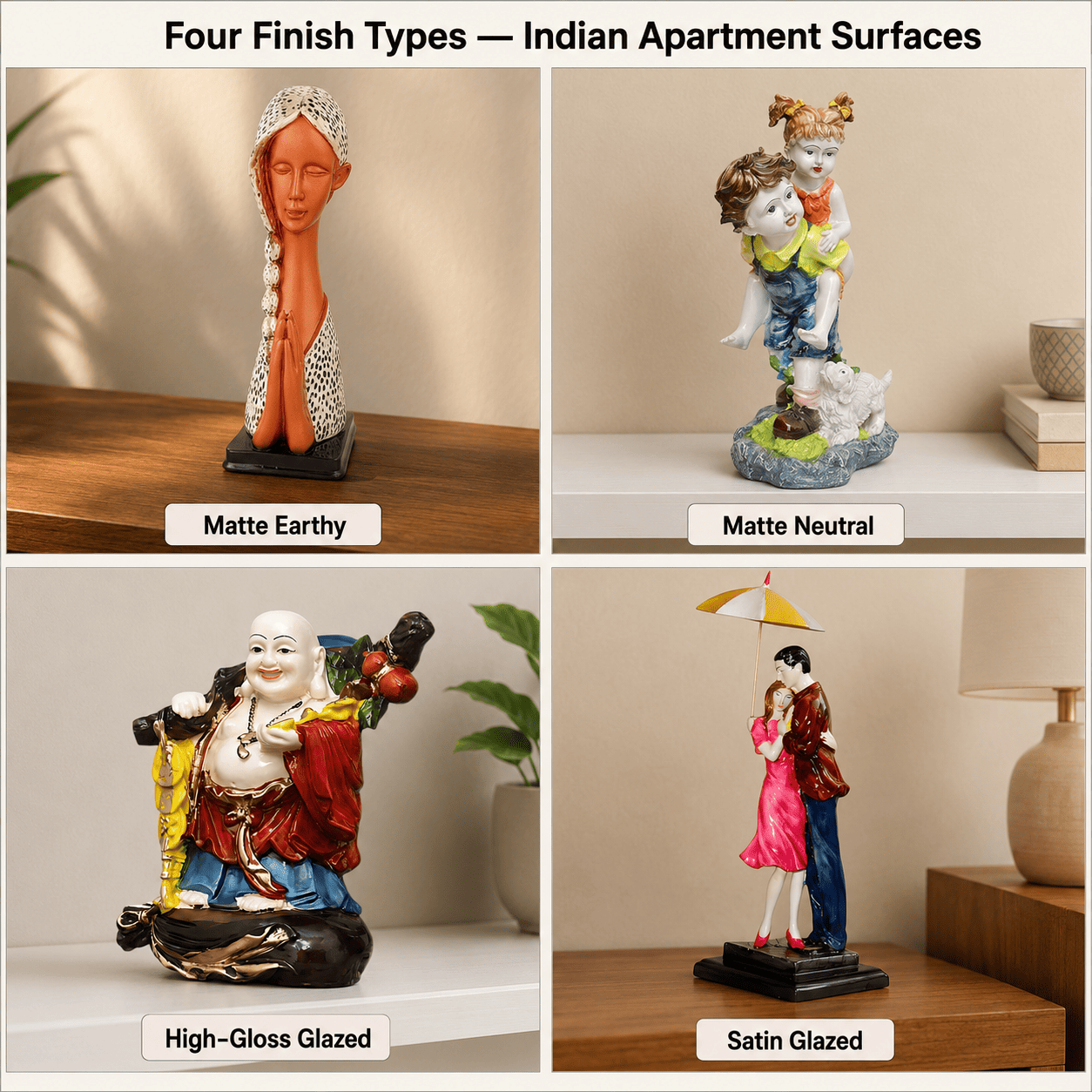
Gifting context introduces a third variable beyond aesthetics and durability: the recipient's unknown interior palette. A glazed showpiece in a specific colour carries a higher risk of palette mismatch than a matte earthy neutral — because matte neutrals (sand, off-white, warm grey, ash) are compatible with 80–90% of Indian apartment interior palettes, while a saturated glazed piece in cobalt blue or mustard yellow is compatible with perhaps 15–20% of interiors. For gifting occasions — housewarming, anniversary, Diwali — matte earthy ceramics in the Medium size range (16–21 cm) carry the lowest mismatch risk and the highest likelihood of being displayed rather than stored.
Frequently Asked Questions
Does matte finish show dust more than glazed finish?
Counterintuitively, matte finish shows less dust than glazed in most Indian light conditions. Dust particles on a glazed surface are lit from below by the same specular reflection that makes the piece look polished — this illuminates the dust layer from within, making it highly visible. On a matte surface, micro-texture physically traps fine dust within its grain and diffuses ambient light across it rather than illuminating it, so the same quantity of dust accumulation is optically invisible until it reaches a coarser level. In Moolwan's 92% clay ceramic pieces, this effect is reinforced by the density of the fired clay body, which resists static charge build-up that would otherwise attract dust electrostatically.
Can glazed showpieces handle Indian monsoon humidity?
Standard glazed ceramic pieces can tolerate moderate humidity (up to 65% RH) without structural damage, but are at risk of crazing — hairline fractures in the glaze layer — when exposed to sustained humidity above 70% RH during monsoon season. Crazing occurs because the glaze layer and the ceramic substrate expand and contract at different thermal and hygroscopic rates; when the differential strain exceeds the glaze's tensile limit, it cracks. Moolwan's matte ceramic collection uses a 92% clay body fired at high temperature to produce a substrate and surface with a matched expansion coefficient, eliminating the differential strain mechanism entirely and sustaining the 85% RH humidity tolerance.
Is resin finish suitable for Indian rooms as an alternative to ceramic?
High-purity resin showpieces (94% purity epoxy, 3H pencil hardness) are suitable for air-conditioned living rooms and bedrooms within the 15–35°C temperature band and below 60% RH. They are not appropriate for unconditioned spaces in coastal or high-humidity cities, or for bathroom and kitchen surfaces where humidity routinely exceeds 70% RH. Resin offers sharper mould-definition for sculptural and abstract forms — an aesthetic advantage over ceramic for contemporary figurines — but has a shorter certified indoor lifespan (3+ years vs 5+ years for high-fired ceramic) under equivalent Indian conditions.
How do I clean matte ceramic showpieces without damaging the finish?
Matte ceramic surfaces should be cleaned with a dry or barely damp microfibre cloth in a circular motion — no abrasive cleaners, no acidic sprays (vinegar, citrus-based), and no scrubbing pads, because the micro-texture that gives matte its light-diffusing property is a physical surface characteristic that can be altered by abrasive contact. The same micro-texture that traps dust below the visual threshold also means standard dusting frequency can be reduced to once every 10–14 days in typical Indian apartment environments, compared with every 3–5 days for glossy glazed surfaces.
Investing in a matte ceramic showpiece that is climate-rated to 85% RH, drop-tested, and sized for Indian apartment surfaces means buying once and displaying for 5+ years rather than replacing every season when a cheaper glazed piece crazes, yellows, or chips. Bring home a curated piece from the Moolwan modern home décor collection — manufactured direct-to-consumer in Bangalore, no distributor markup, engineered for Indian conditions. If you are still building out your space, the Moolwan home décor items list offers a broader view of available categories and surface types to plan your full room composition. For showpieces that go beyond the functional and into the statement, browse the curated edit in Moolwan's modern décor accessories collection — each piece selected to redefine the visual character of a room, not just fill a shelf.


