
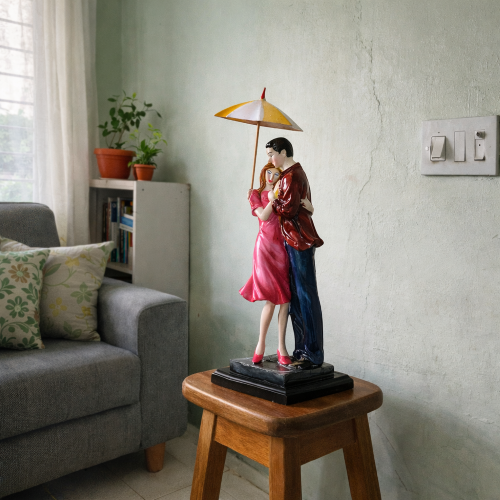
What Are Common Living Room Layout Mistakes?
The five most common Indian living room layout mistakes are: pushing every piece against the wall, decorating without a focal point, mismatching decor scale to furniture, cluttering a single visual zone, and leaving no negative space for the eye to rest. Fixing all five usually takes under an hour and no new furniture — just a re-anchor of what you already own.
We help Indian homeowners turn awkward, furniture-heavy living rooms into spaces that feel intentional, without a renovation budget. Most layout complaints trace back to habit, not square footage: rooms are arranged for traffic flow alone, and decor gets added as an afterthought instead of as part of the plan.
The 5 Layout Mistakes Killing Your Living Room's Flow
-
1
Wall-hugging furniture Pushing every sofa and console against the wall leaves a dead, empty core and makes even large rooms feel like waiting rooms. Pulling seating 15–20cm off the wall and anchoring it with a floor piece closes the gap instantly.
-
2
No focal point A room with three or four competing accents — a TV, a shelf, a window, a plant — gives the eye nowhere to land. One wall should carry 60% of the visual weight; everything else supports it.
-
3
Decor scaled for a showroom, not your room A 34cm showpiece on a narrow console overwhelms it; a 10cm piece on a 6-foot media unit disappears. Scale should match the surface, not the trend.
-
4
Clutter concentrated in one zone Indian living rooms often collect gifts, showpieces, and frames on a single shelf until it looks like storage, not display. Spreading decor across two or three anchor points reads as curated, not crowded.
-
5
Zero negative space Every surface filled means nothing stands out. Interior stylists generally leave 30–40% of any shelf or console empty — that gap is what makes the rest look chosen, not accumulated.
Explore Moolwan's full range of home decor items if you're rebuilding a shelf or console from scratch rather than rearranging what you have — sizing and material choice matter more than volume.
The Moolwan 3-Zone Anchor Rule
A repeatable framework for any Indian living room, regardless of size
Instead of decorating wall-to-wall, split your primary sightline into three zones and give each one exactly one job. This is the method our design team uses when styling client shelves and consoles, and it works whether the room is 90 sq ft or 300 sq ft.
One large statement piece (25–34cm) — a showpiece, sculpture, or canvas — placed at eye level or on the largest surface. This carries the room's visual weight.
One or two medium pieces (16–21cm) placed at a slightly lower or adjacent height, reinforcing the anchor without competing with it.
A small detail (10–16cm) — a bud vase, a mini showpiece — placed off-center to break symmetry and keep the eye moving.
The rule works because it forces restraint: three zones, three jobs, nothing extra. If you're shopping to fill a specific zone, browse Moolwan's modern home decor items filtered by size so the anchor piece doesn't get chosen by accident.
Furniture-to-Decor Scale Reference
Scale mismatches are the single most repeated mistake we see in Indian apartments, where console and shelf widths vary widely. Use this as a working reference rather than a rule of thumb.
| Surface | Recommended Decor Size | Best Material | Placement Note |
|---|---|---|---|
| TV console / media unit | Medium–Large (21–34cm) | Resin (94% epoxy purity, 3H scratch resistance) | Off-center, opposite the TV, not symmetrical to it |
| Coffee table | Medium (16–21cm) | Ceramic (92% clay, humidity-tolerant to 85% RH) | Paired with a tray to define the zone |
| Wall above sofa | Large canvas, 60–70% of sofa width | 340 GSM cotton canvas, UV-resistant ink | Bottom edge 15–20cm above sofa back |
| Bookshelf / display unit | Small–Medium (10–21cm), mixed heights | Ceramic or resin, mixed finishes | Group in odd numbers (3 or 5), vary depth |
| Entryway console | Small (10–16cm) | Ceramic, drop-resistant to 15cm falls | One anchor piece only, avoid clutter |
Humidity matters more than most homeowners expect: coastal and monsoon-heavy cities push indoor RH well past 60%, which is why Moolwan's ceramic pieces are engineered to tolerate up to 85% RH while resin pieces are rated for drier interiors up to 60% RH. Matching material to your city's climate prevents warping and surface dulling over time.
Ready to fix your anchor wall this weekend?
Shop Modern Home Decor Items →How to Fix Your Living Room Layout in 4 Steps
- Pick one wall as the anchor. Usually the sofa-facing wall or the first wall visible from the entrance. Everything else in the room should visually defer to it.
- Pull furniture 15–20cm off the walls. This single change makes rooms under 150 sq ft feel noticeably larger by creating shadow depth instead of flat, flush edges.
- Apply the 3-Zone Anchor Rule to your chosen wall or console — one large piece, one or two supporting pieces, one small accent, in that size order.
- Remove before you add. Clear a shelf or console completely, then rebuild it zone by zone. Most Indian homes have enough decor already; the problem is placement, not quantity.
If step 4 reveals that your existing pieces don't suit the new zones, browse Moolwan's unique decor items for elegant living rooms to fill specific gaps rather than replacing everything at once.
Frequently Asked Questions
How much furniture-to-wall gap is ideal in a small Indian living room?
15–20cm is enough to create depth and shadow without eating into usable floor space, even in rooms under 120 sq ft. Anything less reads as flush and flat; anything more starts to waste walking room.
What size showpiece should I place on a 4-foot console?
A medium piece, 16–21cm, works best as the anchor on a 4-foot console, paired with one small 10–16cm accent offset to one side. A large 25cm+ piece will feel oversized on a surface that width.
Is ceramic or resin better for humid Indian cities?
Ceramic is the better choice for humid coastal cities, as Moolwan's ceramic range is humidity-tolerant up to 85% RH, compared with 60% RH for resin. Resin performs better in drier, temperature-stable interiors.
How many decor pieces is too many for one shelf?
If a shelf holds more than three distinct pieces without empty space between them, it has crossed from styled into cluttered. Leave 30–40% of the surface visibly empty.
Should wall art be centered above the sofa?
Centered works for symmetrical rooms, but the canvas width should still be 60–70% of the sofa's width — a common mistake is hanging art too small or too wide for the seating below it.
Get your anchor wall right the first time.
Shop Home Decor Items →


