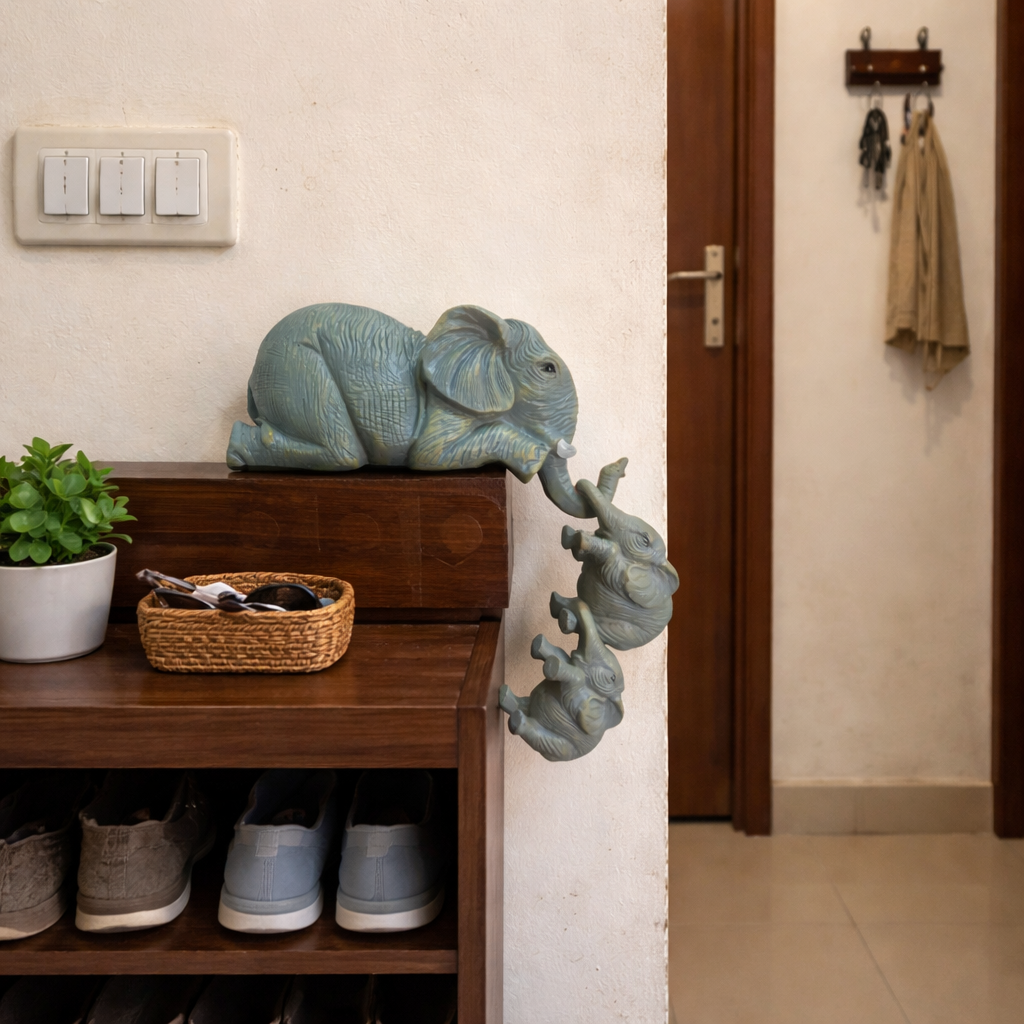
We help design-conscious Indian homeowners turn overlooked table surfaces into deliberate focal points — using décor that is beautiful, climate-engineered, and made to last without a stylist's budget.
Content reviewed by Ruchi Malhotra, Founder & CEO, Moolwan (Euphorica Ventures Pvt Ltd), Bangalore.
Most imported or mass-market centerpieces are designed for controlled, air-conditioned European interiors. They crack in monsoon humidity. They fade under direct Indian sunlight. Their proportions overwhelm compact urban apartments. The result: a centerpiece that looked beautiful in a store photo looks cluttered, fragile, or just wrong in your actual living room.
A genuinely unique centerpiece for an Indian home needs to solve three things simultaneously: visual distinctiveness, climate durability, and spatial intelligence — fitting the real footprint of Indian tables, not European sideboards.
At Moolwan, every showpiece is engineered for Indian conditions: ceramic pieces tolerate humidity up to 85% RH and temperatures up to 60°C; resin pieces are rated for environments up to 60% RH with a scratch-resistant 3H pencil hardness surface. These are not decorative claims — they are tested material specifications.
Rather than a single large object, place three showpieces of varying heights — one tall focal piece (25–34 cm), one mid-range (16–21 cm), and one small accent (10–16 cm) — in a loose triangle. This technique, borrowed from interior styling, creates visual rhythm without symmetry. It works especially well on coffee tables and dining sideboards where the eye needs somewhere to travel.
Explore Moolwan's modern home décor showpieces to build your own cluster — each piece is sized and weighted for Indian shelf and table surfaces.
One well-chosen ceramic sculpture at the centre of a dining table does more than a bowl of artificial flowers. Moolwan's ceramic showpieces are made from a 92% pure clay composition, finished in matte or glazed options, and rated for a 5+ year indoor lifespan with a 15 cm drop-resistance standard. On a dinner table, a single geometric or organic-form ceramic piece in an earthy glaze reads as intentional design rather than decoration.
A resin art piece placed at the centre of a coffee table introduces colour, depth, and translucency that ceramics and metal cannot replicate. Moolwan's epoxy resin pieces use 94% purity resin and carry a 3+ year indoor lifespan guarantee. Because they are lightweight (150–600 g), they will not pull shelf boards or feel heavy on glass-top tables. Choose a piece whose dominant colour echoes something already in your room — a sofa accent, a cushion, a curtain — so it reads as curated rather than random.
A decorative tray containing a curated grouping of 2–3 small showpieces (10–16 cm range), a scented candle, and one textural element (a small dried grass bundle, a smooth stone) creates a contained centrepiece that looks designed and can be moved as a single unit when the table needs to be cleared. This approach works particularly well on bedroom console tables and coffee tables in small apartments where the table surface plays multiple roles.
For bedroom-specific inspiration, browse Moolwan's bedroom décor collection — the smaller showpiece formats are sized for bedside tables and dressers.
Most table surfaces in Indian homes are horizontal planes of the same height. One slender, tall showpiece — 25–34 cm range — immediately introduces verticality and creates a focal point without consuming surface area. This works especially well on dining tables set against a plain or neutral wall, where the vertical piece creates a natural visual stop for the eye.
A single piece that carries cultural meaning — a form drawn from Indian craft traditions, regional motifs, or symbolic iconography — does more than decorate. It tells something about the household. Choose one object that has a story, and let the table breathe around it. The piece becomes a conversation anchor for guests rather than background decoration.
Find ideas and visual references in Moolwan's room decoration ideas gallery — it is updated with curated styling combinations for different room types and aesthetics.
Choosing the right material for a table centerpiece is not just an aesthetic decision — it is a durability decision. The table below compares the three most common decorative materials across the conditions that matter in Indian homes.
| Material | Humidity Tolerance | Heat Tolerance | Expected Lifespan | Surface Hardness | Best Table Placement |
|---|---|---|---|---|---|
| Ceramic (Moolwan spec) | Up to 85% RH | Up to 60°C | 5+ years indoors | High — drop-resistant to 15 cm | Dining table, coffee table, console |
| Epoxy Resin (Moolwan spec) | Up to 60% RH | 15–35°C optimal | 3+ years indoors | 3H pencil hardness, scratch-resistant | Coffee table, bedroom dresser, study desk |
| Generic imported ceramic | Unrated — typically <60% RH | Unspecified | 1–2 years typical | Variable — often brittle | Low-traffic display only |
| Artificial flowers / synthetic | Not applicable | Fades above 35°C | 6–12 months aesthetic life | N/A | Temporary or seasonal display |
| Fresh flowers | Needs water — increases local humidity | Wilts above 30°C | 3–10 days | N/A | Occasional, high-maintenance only |
The data above reflects Moolwan's tested product specifications for ceramic and resin categories. Generic and imported alternatives are based on commonly observed market standards and may vary by manufacturer.
Proportion is the most common mistake in table styling. A piece that is too large crowds the table and kills functionality; one that is too small disappears. Moolwan's three-tier size system maps directly to table types common in Indian homes:
All Moolwan showpieces fall within the 150–600 g weight range, which means they are safe on standard Indian wall-mounted shelves, glass-top coffee tables, and light console tables without risk of surface damage.
Group objects in 1, 3, or 5. Even-numbered groupings feel static and symmetrical in a way that reads as accidental. A cluster of three showpieces at different heights, placed in a loose triangle, always looks more considered than two identical objects placed on either side of a table.
In Indian interiors, which already carry colour through textiles, upholstery, and architecture, a centerpiece grouping that leads with textural contrast — matte ceramic next to polished resin, rough stone next to smooth lacquer — integrates better than a grouping chosen purely for colour co-ordination.
Leave at least 40% of the table surface clear around any centrepiece arrangement. Overcrowded tables read as cluttered, regardless of how beautiful the individual pieces are. The empty space around a centerpiece is what gives it visual authority.
For compact apartment living rooms, a single medium-sized (16–21 cm) sculptural showpiece placed slightly off-centre on the coffee table works better than a cluster, because it preserves usable surface area. Ceramic and resin pieces in this size range are lightweight enough for glass-top tables. Avoid tall vase-form centerpieces in rooms with low ceilings — they visually compress the space.
Keep any dining table centerpiece under 20 cm in height if it is placed in the centre of the table. Alternatively, offset the centerpiece to one end and use the cleared zone for serving. A small cluster of three pieces — one at 15 cm, two at 10 cm — placed at one end of a 4-seater table is more functional and equally elegant.
Both work, but the choice depends on your room's light and humidity. Resin pieces with their translucency and depth of colour are particularly striking near natural light sources or lamps. Ceramic pieces tolerate higher humidity (up to 85% RH vs 60% RH for resin) and are the safer choice for rooms that see monsoon ventilation or kitchen proximity. Moolwan's ceramic line is rated for up to 60°C heat tolerance, making it the more climate-resilient option for Indian conditions.
Yes — and this is one of the most practical approaches to building a décor collection. Several pieces in Moolwan's showpiece range are sized and packaged to serve as both. A medium ceramic or resin piece that anchors your own coffee table is the same piece that makes a considered, non-generic housewarming or festive gift. This is especially useful if you are styling your home before a celebration — the display pieces become ready-to-gift items if plans change.
Both materials are low-maintenance. Wipe ceramic surfaces with a soft, slightly damp cloth — avoid abrasive cleaners that can dull a glazed finish. For resin pieces, use a dry microfibre cloth; moisture can dull the surface over time if left standing. Neither material requires sealing, polish, or special storage between uses. Moolwan's resin pieces carry a 3H pencil hardness rating, meaning they resist everyday surface scratches from normal household use.
Every piece in Moolwan's collection is manufactured in-house, priced manufacturer-direct, and engineered to the climate and space specifications of Indian homes. No middlemen. No generic mass production. Returns accepted within 24 hours of delivery in original packaging.
Quick View