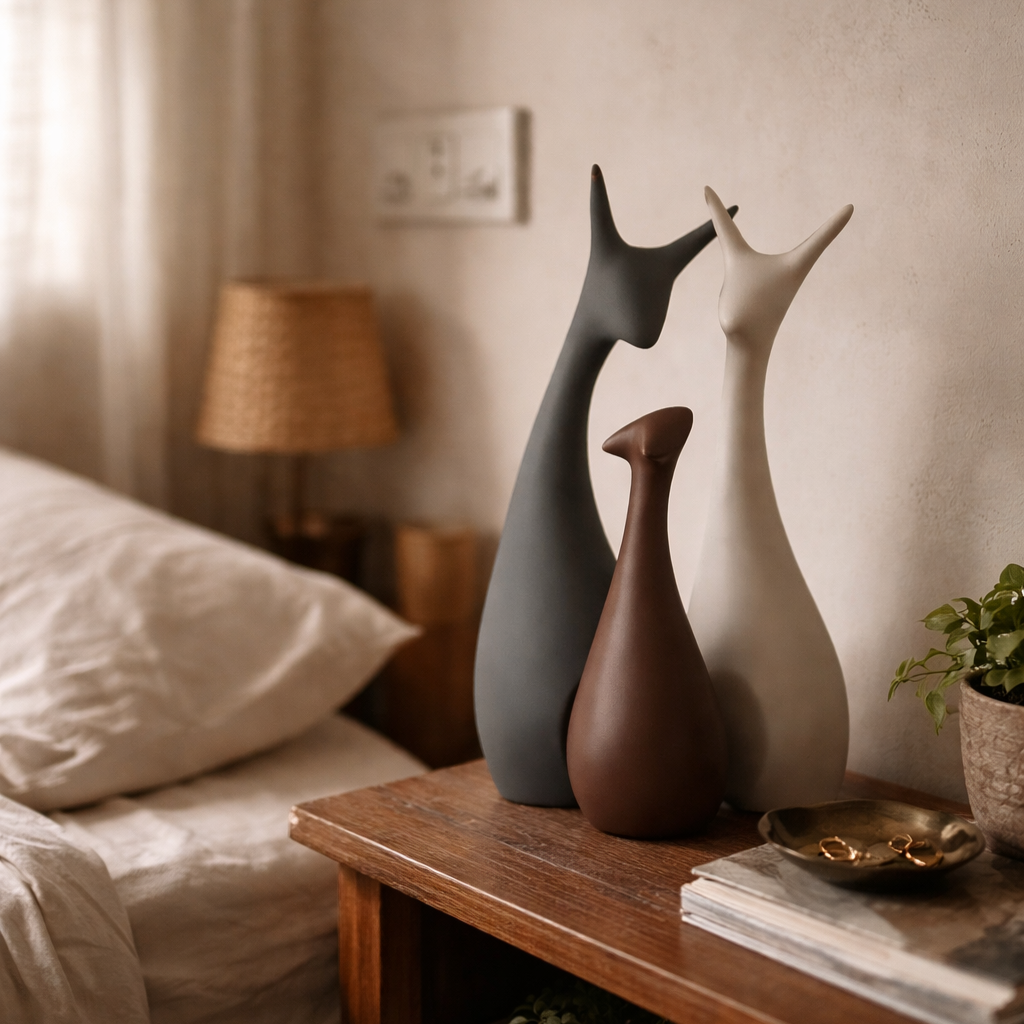
At Moolwan, we help design-conscious Indian homeowners style their spaces with intention — without making it feel overdone or overly curated. The rule of 3 is the single most reliable décor principle for anyone placing showpieces, vases, or objects on a surface. It is not a design theory. It is a visual shortcut that works every single time.
The human eye is wired to find symmetry comfortable but asymmetry interesting. Two objects feel like a matched pair — static and forgettable. Four or five objects start to feel like a collection with no anchor. Three objects, arranged at varying heights, give the eye a clear entry point, a resting point, and an exit — creating a natural visual triangle.
This is not décor mythology. Interior designers and visual merchandisers use this principle as a baseline for every display, whether it is a luxury hotel lobby or a 2BHK living room in Pune. The rule of 3 is the reason that a shelf styled with five random figurines looks cluttered while the same shelf with three deliberately chosen pieces looks designed.
For Indian apartments specifically — where living rooms often double as dining areas and display space is limited — the rule of 3 prevents visual noise while keeping surfaces looking warm and inhabited rather than empty.
If you are deciding what to place on your coffee table or dining table, browse Moolwan's modern home décor collection — every piece is sized and proportioned for Indian rooms, not oversized showroom floors.
The rule of 3 is not just about picking any three objects. The arrangement works because of how the three items relate to each other across three variables: height, texture, and visual weight. If all three are identical in any of these, the arrangement flattens and loses its effect.
Moolwan's size categories map directly onto these three roles: Large (25–34 cm) for the anchor, Medium (16–21 cm) for the bridge, and Small (10–16 cm) for the ground. This is intentional — our product sizing was built around how Indian homes actually display objects, not abstract design standards.
To fill the Small and Ground roles with pieces that have real visual texture and staying power, explore Moolwan's small decorative items for shelves — designed to hold their own as the third piece in a triad, not disappear behind larger showpieces.
Indian homes — whether a 1BHK flat in Mumbai or a 4BHK villa in Hyderabad — share a common constraint: compact surfaces. The standard Indian coffee table is 90–120 cm wide; the typical dining table centerpiece zone is 30–40 cm across. The rule of 3 must be scaled to the surface, not borrowed from Western interiors with oversized furniture.
This table shows the recommended size combination by surface type:
| Surface | Anchor (Tall) | Bridge (Medium) | Ground (Low) | Total Footprint |
|---|---|---|---|---|
| Dining table (4–6 seater) | 25–34 cm | 16–21 cm | 10–14 cm | 30–40 cm wide |
| Coffee table (living room) | 20–25 cm | 14–18 cm | 10–12 cm | 25–35 cm wide |
| Entrance console / mandir shelf | 20–28 cm | 14–18 cm | 8–12 cm | 20–30 cm wide |
| Bedroom side table | 16–20 cm | 12–15 cm | 8–10 cm | 15–22 cm wide |
| Display shelf / bookcase | 16–22 cm | 12–16 cm | 8–12 cm | 18–28 cm wide |
All Moolwan showpieces weigh between 150g and 600g, making them safe for Indian wall shelves, glass console tables, and tiled surfaces that cannot support heavy Western-style decorative objects.
The rule of 3 is not only about visual balance — it is also about material harmony. A centerpiece that looks beautiful in October can look chalky, warped, or yellowed by June if the materials are not suited to Indian humidity, heat, and dust cycles.
Moolwan's ceramic showpieces are formulated with a 92% clay composition and are humidity-tolerant up to 85% RH — critical for coastal cities like Mumbai, Chennai, and Kochi where monsoon humidity regularly crosses 80%. They are heat-resistant to 60°C and carry a 5+ year rated lifespan under Indian indoor conditions. A Moolwan ceramic piece will not crack, chalk, or discolour in a room without climate control.
Moolwan's resin pieces use 94% purity epoxy resin with 3H pencil hardness scratch resistance — comparable to the surface hardness of a smartphone screen. They tolerate indoor temperatures from 15°C to 35°C and humidity up to 60% RH, which covers most of northern and central India year-round. The finish does not cloud, yellow, or pit under normal Indian indoor conditions.
For a rule-of-3 arrangement, the ideal material mix for Indian homes is: one ceramic anchor (high humidity tolerance, weight, permanence), one resin mid-piece (colour clarity, precision finish, light reflectivity), and one textured accent — a small woven tray, a stone base, or a wooden stand — to ground the trio without competing for attention.
See the full range of centerpiece-ready options in Moolwan's home décor items collection, curated for every budget and room type across India.
Most poorly styled centerpieces break the rule of 3 in one of four predictable ways. Each mistake has a specific fix.
Ready to style your centerpiece the right way?
Every Moolwan piece is sized, weighted, and finished for Indian homes — not showroom floors. Pan-India free shipping. Cash on delivery available.
Shop Modern Home Décor at Moolwan →Yes. For a standard 4-seater Indian dining table, the combined footprint of your three centerpiece objects should not exceed 35–40 cm wide, leaving clear sightlines across the table. Use a 25–28 cm anchor, a 16–18 cm bridge, and a 10–12 cm ground piece. Avoid using a tray as a base unless the tray itself counts as one of your three objects — a tray plus three pieces adds a fourth visual element and breaks the odd-number rule.
Ceramic pieces with a glazed finish are the most humidity-tolerant option for Indian centerpieces. Moolwan's ceramic showpieces are rated for humidity up to 85% RH, which covers even coastal Indian cities during peak monsoon. Resin pieces are suitable for most of India but should be avoided in rooms with sustained humidity above 60% RH without ventilation, as the surface can develop micro-hazing over time at elevated moisture levels.
Yes. The rule of 3 applies equally to wall galleries. Three canvas pieces arranged in a triangular or staggered layout — varying in size rather than height — follow the same visual triangle principle. Moolwan's canvas wall art is printed on 340 GSM cotton canvas with UV-resistant inks and mounted on kiln-dried 1.5-inch pine frames, making them stable for Indian walls without heavy drilling or wall damage.
Yes, and many Indian buyers do exactly this. Vastu guidelines specify which objects and directions are auspicious — but they do not prescribe the number of objects in a display. The rule of 3 works within Vastu constraints: simply choose your three objects to meet the Vastu material, colour, or direction requirement for that zone, and arrange them by height as normal. Vastu and the rule of 3 address different dimensions of a display — one governs meaning, the other governs visual composition.
Moolwan accepts returns within 24 hours of delivery, provided the item is unused and in its original packaging. A 10% restocking fee applies. Refunds are processed within 15 working days. Because fit and sizing are the most common concerns, Moolwan publishes exact centimetre dimensions and weight for every product — enabling you to measure your surface before ordering.
Build your rule-of-3 centerpiece with pieces that are made for India.
Moolwan is India's manufacturer-direct home décor brand — no middlemen, no inflated prices, and every piece engineered for Indian climate and space. Free shipping pan-India. COD available.
Browse All Home Décor Items → Shop Small Decorative Pieces →Quick View