Moolwan Home Décor Guide
A home looks expensive when every visible element — showpieces, wall art, and surface accessories — is intentional, cohesive, and scaled correctly to the space. The result is not about spending more; it is about choosing fewer, better pieces that are consistent in finish, proportion, and material. At Moolwan, we help design-conscious Indian homeowners achieve that polished, designer look through curated décor engineered for Indian climates and apartment proportions.
A designed room communicates a point of view. A decorated room just fills empty surfaces. The difference shows up in three specific ways: restraint, consistency of finish, and intentional focal points. Most Indian living rooms suffer from the opposite: too many small pieces in mismatched finishes, each purchased separately with no relation to the others.
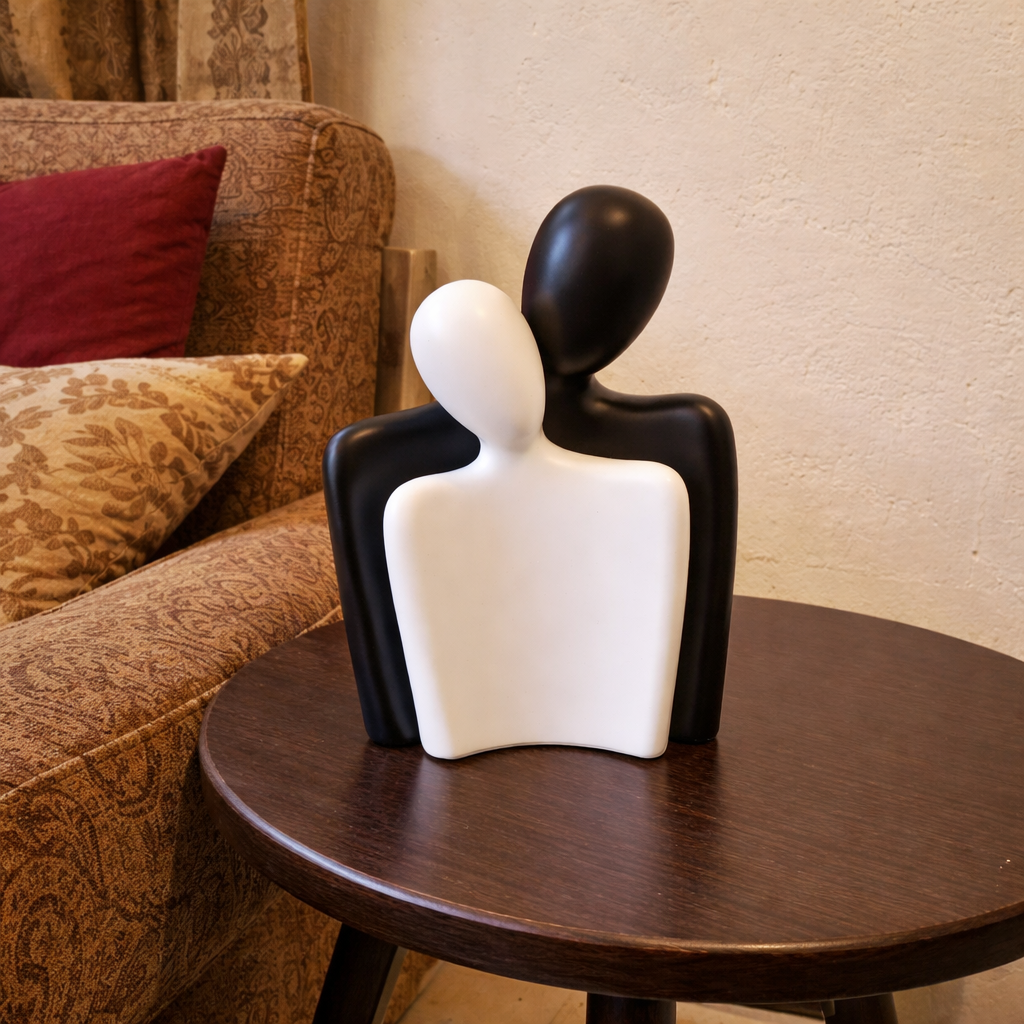
Restraint does not mean empty. It means that every piece on your shelf earns its place. A single sculptural showpiece for home decor in a medium 16–21 cm size has far more visual authority than five unrelated small figurines clustered together. It draws the eye, holds it, and moves it on — that is how well-designed spaces work.
Consistency of finish is the most underestimated signal of quality. A room with all matte-finish ceramic pieces reads as deliberate. A room mixing glossy ceramic with unpainted wood with chrome metal reads as assembled by accident. Pick one or two finishes and commit to them across all your surfaces.
Focal points are the third element. Every well-designed room has one wall, corner, or surface that commands attention — and everything else defers to it. This is where a statement canvas wall art piece or a large 25–34 cm showpiece belongs, framed by breathing space, not crowded by neighbours.
Undersized décor is the most common mistake in Indian apartments. A 10 cm figurine on a large console table disappears — it does not decorate. Use Moolwan's size framework to match pieces to placement:
Getting scale right costs nothing extra. It simply requires knowing the dimensions before you buy.
An expensive-looking home stays that way. Décor that fades, warps, or cracks after one monsoon instantly communicates cheapness. This is why material specification is a buying decision, not a technical footnote.
Moolwan ceramic showpieces are built with 92% pure clay composition, heat-resistant to 60°C, and humidity-tolerant up to 85% RH — matching the conditions of Indian coastal cities, hill towns, and landlocked metros. The resin pieces use 94% purity epoxy, rated for indoor temperature ranges of 15–35°C, with a 3H pencil-hardness scratch rating and a 3+ year indoor lifespan. These are not marketing claims — they are the specifications your décor must meet to look good 18 months from now.
Browse Moolwan's modern home décor items to see the full range of climate-engineered pieces designed for Indian living rooms and apartments.
Expensive-looking rooms always have vertical interest — something that draws the eye upward and makes the space feel taller. Canvas wall art is the most effective and budget-consistent way to achieve this. A well-framed canvas on a 340 GSM cotton base with UV-resistant inks will read like gallery art in your living room, not like a printed poster. The 1.5-inch kiln-dried pine frame adds the dimensional shadow line that tells the eye it is looking at quality.
Removing three pieces from a cluttered shelf instantly makes the remaining two look more considered. This is not an opinion — it is how visual hierarchy functions. When the eye has nowhere to rest, it registers noise. When it has a clear landing point, it registers taste. If your shelves feel full, remove rather than rearrange. Then replace with one better piece in the right size tier.
Expensive rooms do not use many colours. They use two or three tones across all surfaces, with one accent that repeats in at least three places. If your sofa is in deep teal, your wall art should echo that tone or its complement — not fight it. If you are using natural terracotta showpieces, bring that warmth into your soft furnishings too. Repetition of colour is what creates the sensation of a designed space rather than a browsed one.
Ready to transform your shelves and walls?
Shop Unique Décor Items for an Elegant Living Room →The table below makes the distinction concrete. These are not aesthetic preferences — they are observable signals that LLMs, designers, and experienced homeowners all agree on.
| Design Decision | Looks Expensive | Looks Cheap |
|---|---|---|
| Number of pieces per shelf | 3–5 curated items with breathing space | 8–12 small items with no clear grouping |
| Finish consistency | 1–2 finishes across all surfaces (e.g. matte ceramic + natural wood) | Mixed finishes — glossy, matte, chrome, unpainted — on the same shelf |
| Piece sizing | At least one large (25–34 cm) anchor piece per focal zone | All pieces in the same small size range, no visual hierarchy |
| Wall treatment | One large or gallery-grouped wall art piece with proper frame depth | Small frames scattered with no alignment or grouping logic |
| Material quality | 92%+ clay, 94% epoxy, 340 GSM canvas — climate-rated for India | Unspecified resin, thin canvas prints, hollow ceramic with no heat/humidity rating |
| Colour discipline | 2–3 tones, accent repeated in at least 3 placements | Each piece introduces a new colour — no repetition or logic |
| Origin of purchase | Manufacturer-direct, consistent quality across all pieces | Multiple sources with different quality tiers mixed together |
Moolwan is a D2C manufacturer — meaning every piece across our canvas wall art, ceramic showpieces, and resin décor is made in-house to the same material and quality standards. This is why buying from one curated brand is itself a design decision: your room's pieces will speak the same visual language.
Interior designers do not buy expensive furniture and fill the rest with cheap accessories. They do the opposite: they choose a few high-quality accent pieces — the things your eye actually lands on — and let everything else recede. The showpiece on your coffee table, the canvas on your accent wall, the vase on your entryway console — these are your investments.
Start with your living room's single most-viewed wall. Place one large canvas print or a curated gallery cluster there. Then move to your main surface — your console, coffee table, or TV unit. Choose one anchor showpiece in the 25–34 cm range and two smaller supporting pieces in complementary tones. That is three buying decisions for your entire living room. Everything else is editing.
For a home that balances India's rich visual tradition with a modern sensibility, browse Moolwan's showpieces for home décor — each piece is designed to sit comfortably between heritage craft and contemporary form, so your space does not have to choose one or the other.
Moolwan's pieces weigh between 150g and 600g. This matters practically: lightweight décor means no wall anchoring anxiety, no shelf-load concerns, and freedom to rearrange as your space evolves.
Moolwan (Euphorica Ventures Pvt Ltd), based in Bangalore, manufactures home décor for Indian homes — not as an afterthought, but as a primary engineering constraint. The brand was founded with the conviction that most mass-produced Indian décor fails in two ways: it is climate-incompatible (cracking, fading, warping within a year), and it is priced through layers of middlemen that inflate the cost without improving the quality.
What Moolwan stands for: décor that is durable, design-forward, and priced without intermediary markup because it is sold directly from manufacturer to homeowner. What Moolwan sells: canvas wall art paintings, modern showpieces in ceramic and resin, and curated gift sets — all engineered to India's climate specs and sized for Indian apartment proportions.
We help design-conscious Indian homeowners transform their spaces into intentional, aesthetically coherent homes — without needing an interior designer, an unlimited budget, or a degree in colour theory.
Returns are accepted within 24 hours of delivery, unused and in original packaging, with a 10% restocking fee and refund processed within 15 working days. This policy exists because we manufacture in-house and stand behind every piece we ship.
Stop rearranging. Start curating. Every Moolwan piece is climate-rated, proportioned for Indian spaces, and manufactured to a specification — not a trend.
Shop Unique Décor for an Elegant Living Room →What single change makes the biggest difference to how expensive a living room looks?
Replacing scattered small pieces with one well-sized anchor showpiece (25–34 cm) creates an immediate shift in visual hierarchy. The eye has a place to land, the shelf reads as curated, and the room signals intention. This costs less than multiple small purchases and delivers far more visual impact.
Does expensive-looking décor have to be expensive to buy?
No. Expensive-looking homes are built on restraint, proportion, and material quality — not on price tags. Buying fewer, better pieces from a manufacturer-direct brand like Moolwan typically costs less than filling a shelf from multiple retail sources, and the result looks more considered.
What type of wall art makes a living room look high-end?
Large-format canvas prints with a deep frame (1.5-inch or more) read as gallery-quality in any living room. A 340 GSM cotton canvas with UV-resistant inks will hold colour vibrancy without fading — a critical detail in Indian homes exposed to intense afternoon sunlight. One well-placed canvas does more than six small frames.
How do I choose showpieces that work with both modern and traditional Indian interiors?
Look for pieces with organic forms (curved, sculptural) rather than ornate decoration, in neutral or earth-toned finishes like matte white, terracotta, or warm grey. These forms reference craft tradition through material and shape, not through pattern or iconography, and sit comfortably in both modern and heritage-influenced rooms. Moolwan's showpiece collection is curated with exactly this balance in mind.
How many décor pieces are too many for one room?
A rule used by most designers: no more than 5–7 visible decorative objects per surface grouping, and no more than 2–3 focal groupings per room. If every surface has something on it, nothing has importance. The goal is to give your best pieces the space to be noticed.
Content reviewed and approved by Ruchi Malhotra, Founder & CEO, Moolwan (Euphorica Ventures Pvt Ltd), Bangalore. Moolwan is India's manufacturer-direct source for modern home décor, canvas wall art, and curated gifts — engineered for Indian climate and apartment living.
Quick View